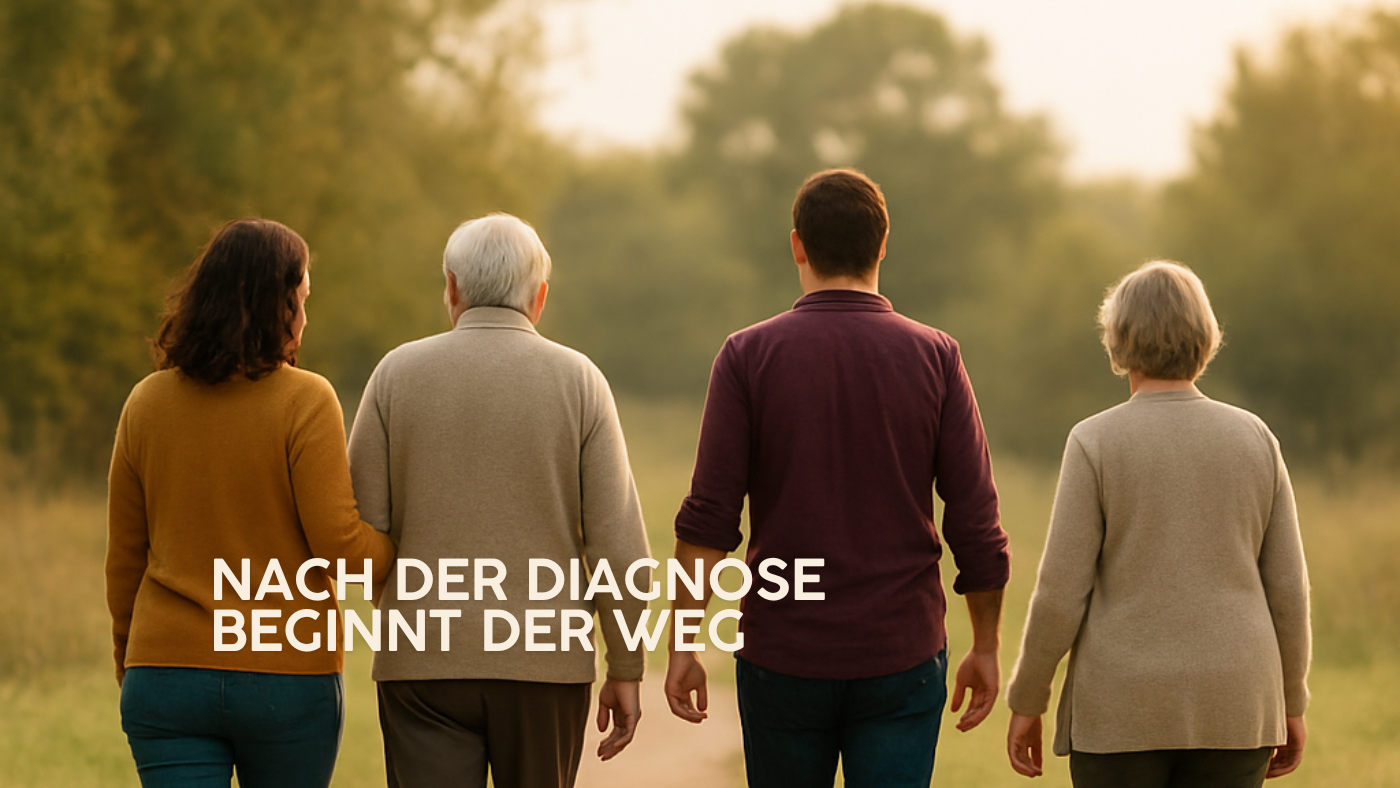
What actually happens after a dementia diagnosis? This question was at the center of the online conference „Diagnosis Dementia – There's a lot to be done...“, which took place in January
Dementia Network Austria was was carried out. This question hits a nerve that extends far beyond the medical system. Because a dementia diagnosis is not a neutral moment. It marks a transition in life. A transition that requires orientation, relationships, and reliable support. Or, as was aptly stated in the post-conference review:
„A dementia diagnosis is not a single medical act, but the beginning of a sensitive transition.“
1. Not about us – but with us
A central idea of the conference was that far too often around the topic of dementia
over the affected individuals, relatives, and loved ones are spoken to, and too rarely with them. That this must change has also
Article by Marianne Buchegger in The Standard picked up: „Diagnosis Dementia: Don't talk about us without us“ (worth reading and highly relevant to the conference discussions). The online conference picked up exactly here: Voices of people with dementia, their partners and relatives, and experts from medicine, psychology, nursing, counseling, self-help, and science were placed side-by-side on an equal footing. Not to present quick solutions, but to make visible where structures support and where they (still) fail.
2. Why I am committed here
I've been a member of the club for many years
Safety net. Originally, I joined the project as an external evaluator
„Mindful 8“ joined – and I stayed because the approach convinced me: to listen, to take seriously, to think ahead together. My own commitment – not just regarding dementia – is closely linked to questions of equal opportunity and equal dignity. As a future psychosocial counselor (LSB), I repeatedly experience how much support depends on,
- where someone lives,
- how many resources are available,
- what options someone has
- and whether suitable accompaniment can even be found.
Or, as the retrospective says:
„Overwhelm of patients and their loved ones is not an individual failure, but a systemic effect of fragmented structures.“ This perspective is important to me because it moves away from assigning blame and towards societal responsibility.
3. Think socially, not individually
Dementia never affects individuals alone. It affects relationships, families, neighborhoods – and ultimately all of us. We all get older. And many of us will eventually face limited mobility, altered sensory perception, or increased dependency. Perhaps you are familiar with these perspective-shifting formats: walks with a restricted field of vision, with earplugs, or with walkers. They vividly demonstrate how much our environment, language, and structures determine whether participation remains possible or not. That is precisely why dementia is not purely a medical issue.
„Dementia is not just a medical task, but a societal one.“
4. Claims intended to remain in effect
Many contributions made it clear that dementia doesn't start suddenly but announces itself quietly – and that the real break is often not the diagnosis itself, but what comes afterward. The aftermath, in which people search for orientation and find forms instead. In which relationships are supposed to sustain while structures are missing. The summary puts it succinctly: „Good support doesn't begin only after the diagnosis but at the moment a suspicion is expressed.“ This thought ran through my whole day. It reminds us that support is an attitude – and systems become effective when they don't pass people on but walk with them.
Clear demands have emerged from the joint exchange at the conference: for better orientation starting from the diagnosis, for reliable peri- and post-diagnostic support, for the recognition of those affected and their relatives as co-sufferers, for destigmatization, and for structural security instead of ad-hoc solutions. These demands will flow as input into the further development of the dementia strategy. They are not isolated opinions but a distillation of lived experience, professional expertise, and social responsibility.
Thank you for this space
What this work carries are people. In the safety net, for me, these include the association's founder and managing director.
Daniela Martos,
Gert Dressel,
Klaus Wegleitner, Patrick Schuchter,
Katharina Heimerl, Christoph Höbart, Valerie Pechhacker-Preiß, and Ilona Wenger – people I hold in high regard, both professionally and personally. You can find the detailed recap of the online conference, all materials, and further content
here. If this topic resonates with you, I invite you to keep reading, to reflect, and perhaps even to change your perspective. Because a society is not shown by how it deals with strength, but by how it creates opportunities for and with vulnerability. For everyone.
0 Comments