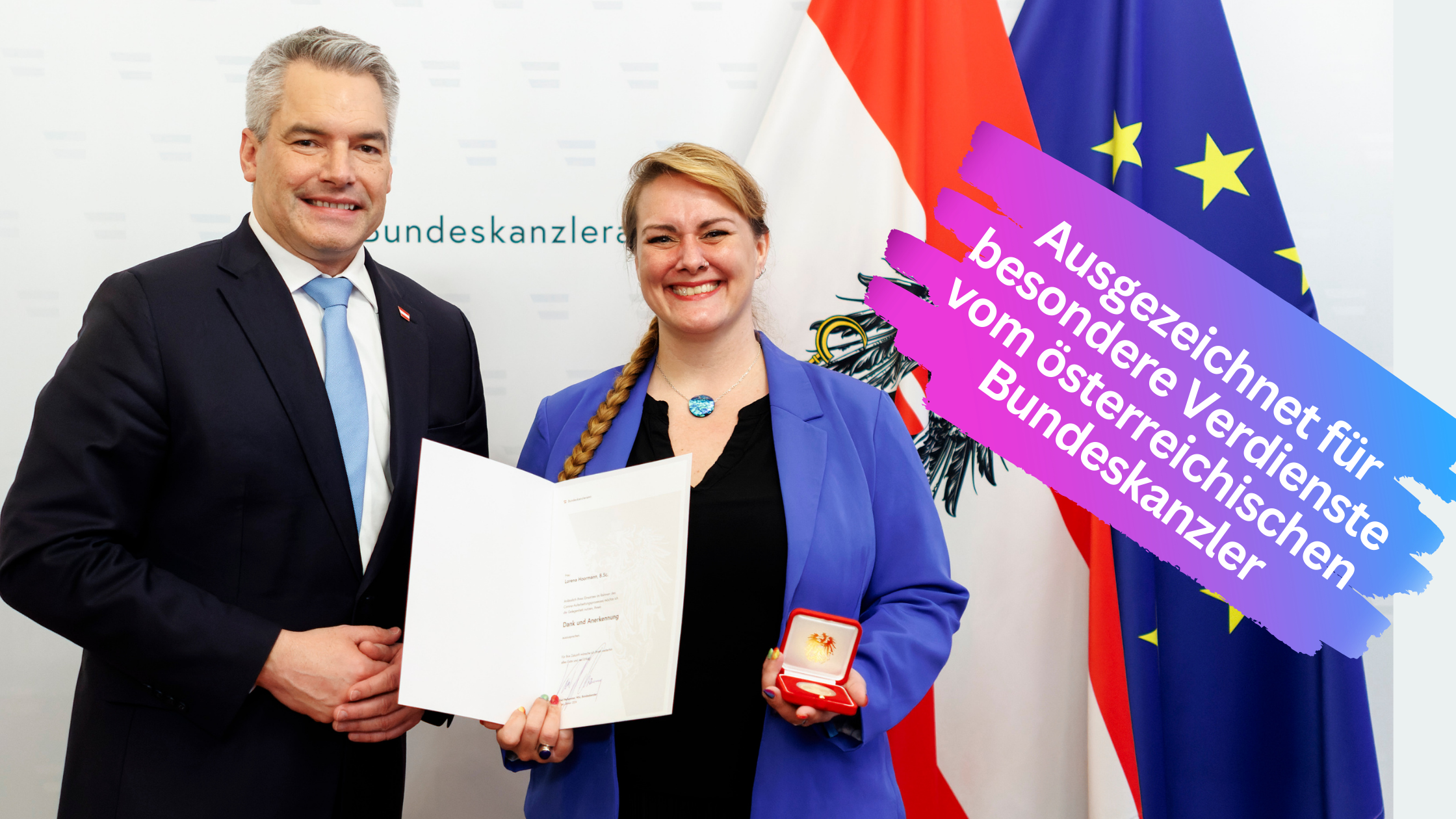
What a week in January! On Monday still in Warsaw at the tattoo studio for my very first tattoo, on Tuesday back to Vienna by night train, and on Wednesday received by the Austrian Federal Chancellor. After the reception, I'll go home with a certificate and a gold medal, as I was recognized for special merits. It says "With thanks and recognition for special merits" in gold on gold for Austria. It is even more special to receive this award as a German. I will tell you in this article what I received this award for and how the award ceremony went.
The reception at the Federal Chancellery
When I received the invitation in mid-January for a reception, I didn't expect much. Although I knew it was related to a project I was involved in during 2023. But truthfully, I didn't expect much. Perhaps a photo opportunity at the Federal Chancellery with everyone involved. Or a quick handshake. But not what it actually turned out to be, that was a real surprise. For me and also for my colleagues. The only information I had was that we should be there at least 15 minutes before the appointment. Before that, I met some colleagues, we went in together, including ID and invitation check, metal detector, and security escort to the small marble room of the Federal Chancellery. There was an orange juice or rosé sparkling wine reception. But we still didn't know what would happen. In retrospect, I learned that at least those responsible for the project from the Federal Chancellery were informed. But no one else.
The Chancellor's speech
After some time, the large double door opened and Chancellor Karl Nehammer entered. After a brief introduction, he gave a speech. I can't recall it word-for-word anymore. It was a truly beautiful speech, very appreciative. He thanked all of us – scientists from the Austrian Academy of Sciences (ÖAW) and the Institute for Advanced Studies (IHS), moderators, and statisticians from Statistik Austria – for the „Corona Recovery Process" enabled. He went for results, explained how personally important it was to him that lessons would be learned from the Corona crisis. That it had not been easy to implement the plan for this process, that not everyone had supported the idea. It became clear that he had really engaged with the content of the results report. Then came the surprise: Everyone who had participated in the project received a certificate and a gold coin, which read: with thanks and recognition for special services to Austria.
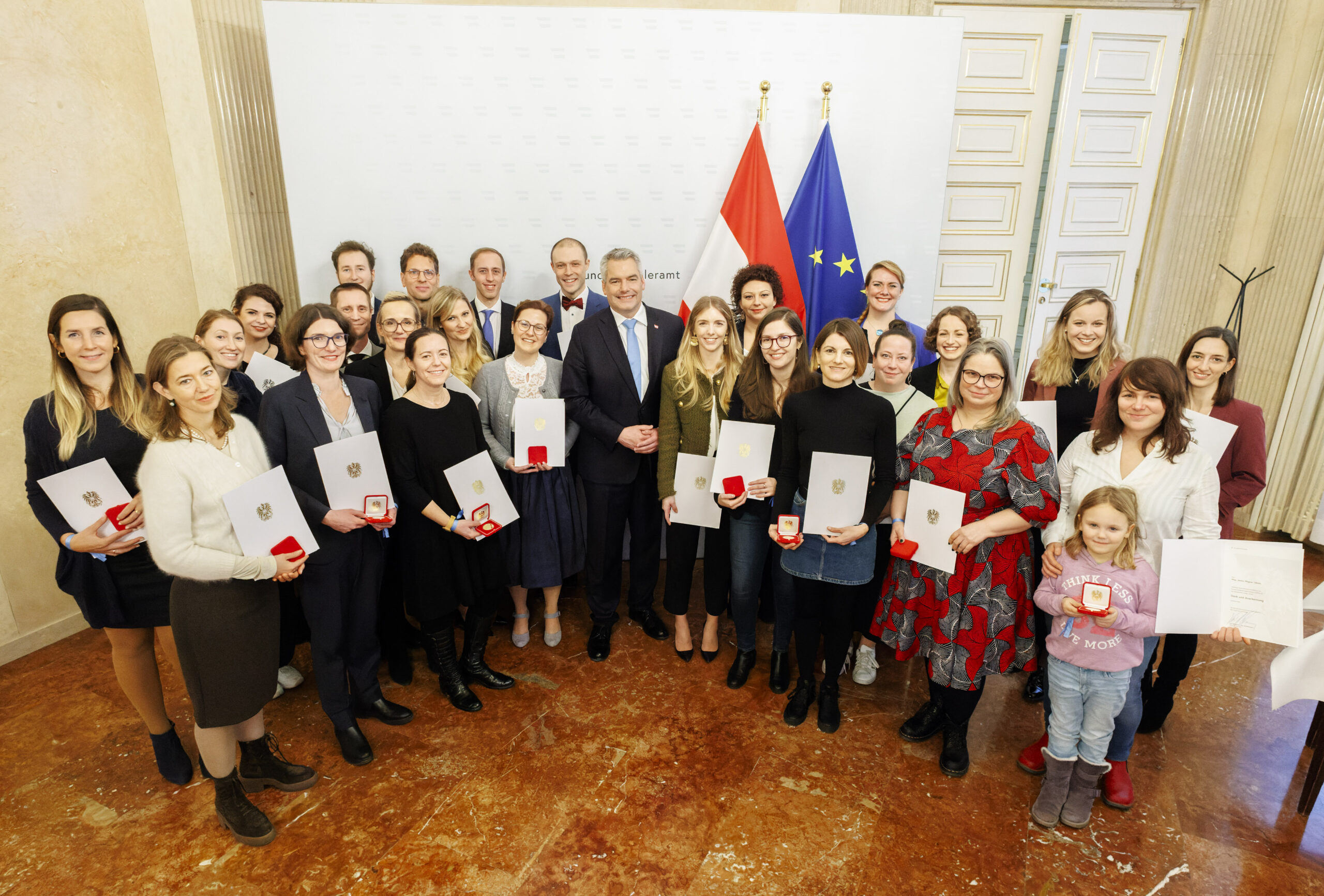
A large portion of the scientists, statisticians, and moderators involved in the Corona recovery process. Unfortunately, not everyone was able to attend the reception (due to illness or other commitments).
The Award for Special Services
After the opening speech came the awards. One by one, we were called up, went forward to the Chancellor, and he presented us with the certificate and the gold medal. Then a photo was taken, and of course, everyone present applauded. This was repeated 25 times. I would have expected it to be over after that, and the Chancellor to move on to his next appointment. However, that was not the case, which positively surprised me. After the official part, sandwiches and dessert pralines were served, as well as wine and beer.
We all, including the Chancellor, remained in the hall for another 1.5 hours for informal discussion. That perhaps made me even happier than the official part. The exchange on an equal footing with colleagues who were part of the project, with the Chancellor, and some of his staff. It was really nice to see everyone again after the project was completed, especially all the colleagues who, like me, were part of the moderation team around Christine Hoffmann.
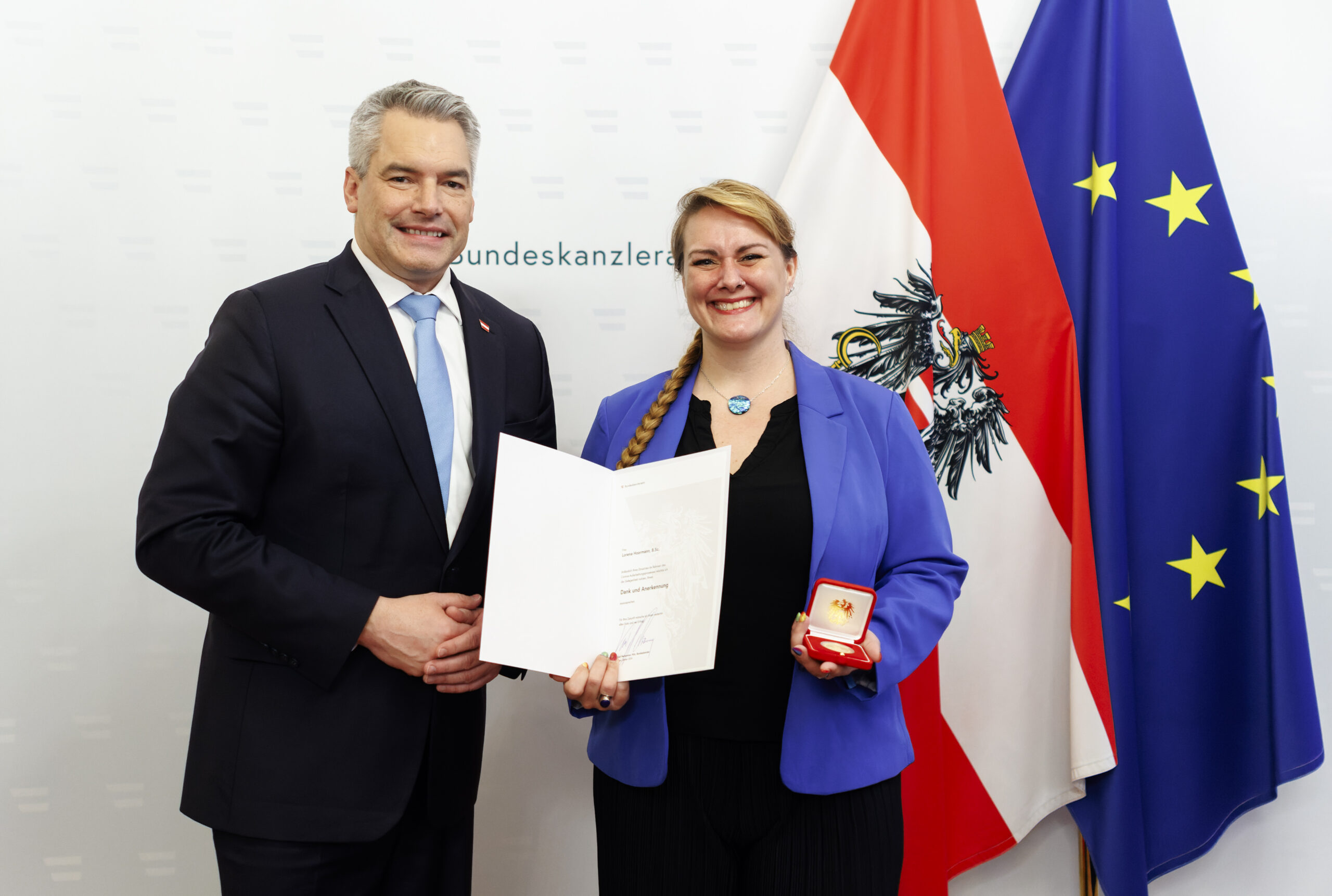
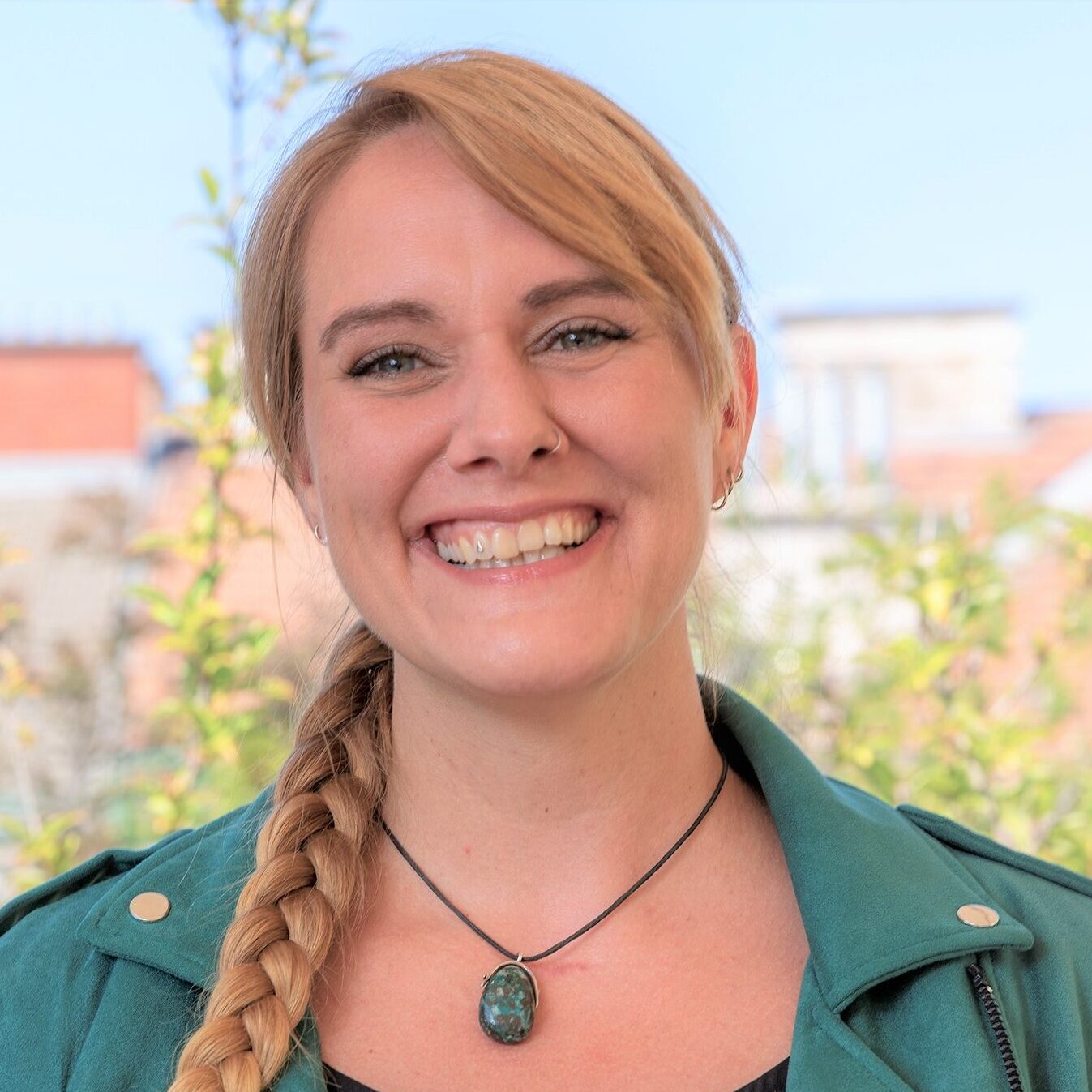
I received an award from Federal Chancellor Karl Nehammer for my contribution to the Corona review process. You can probably see my joy. Holding the certificate was a bit tricky; it was just loosely in the folder and really wanted to sail to the floor.
Working together with many great colleagues
Another surprise for me was running into Alexander Bogner again. I attended some lectures with him during my Master's studies. He was just finishing his postdoctoral qualification (Habilitation), and I was impressed by him as a teacher and his exciting topics, for example, concerning experts and laypeople. He originally inspired my Master's thesis topic (which later changed due to various circumstances). PD Dr. Bogner led the processing on the Austrian Academy of Sciences (ÖAW) side and is the main author of the final report, which is available for download.
From the project, I particularly remember the truly fine collaboration within the moderation team and working together with the scientists very positively. Thank you Ulrike Bechtold (Austrian Academy of Sciences), Stefan Rakowsky (BKA), Katharina Gangl (ihs) for many exciting conversations and a pleasant collaboration. And above all, thank you Christine Hoffmann, for assembling this special team of moderators. It's just something really special when so many moderators with the same attitude work together so smoothly.
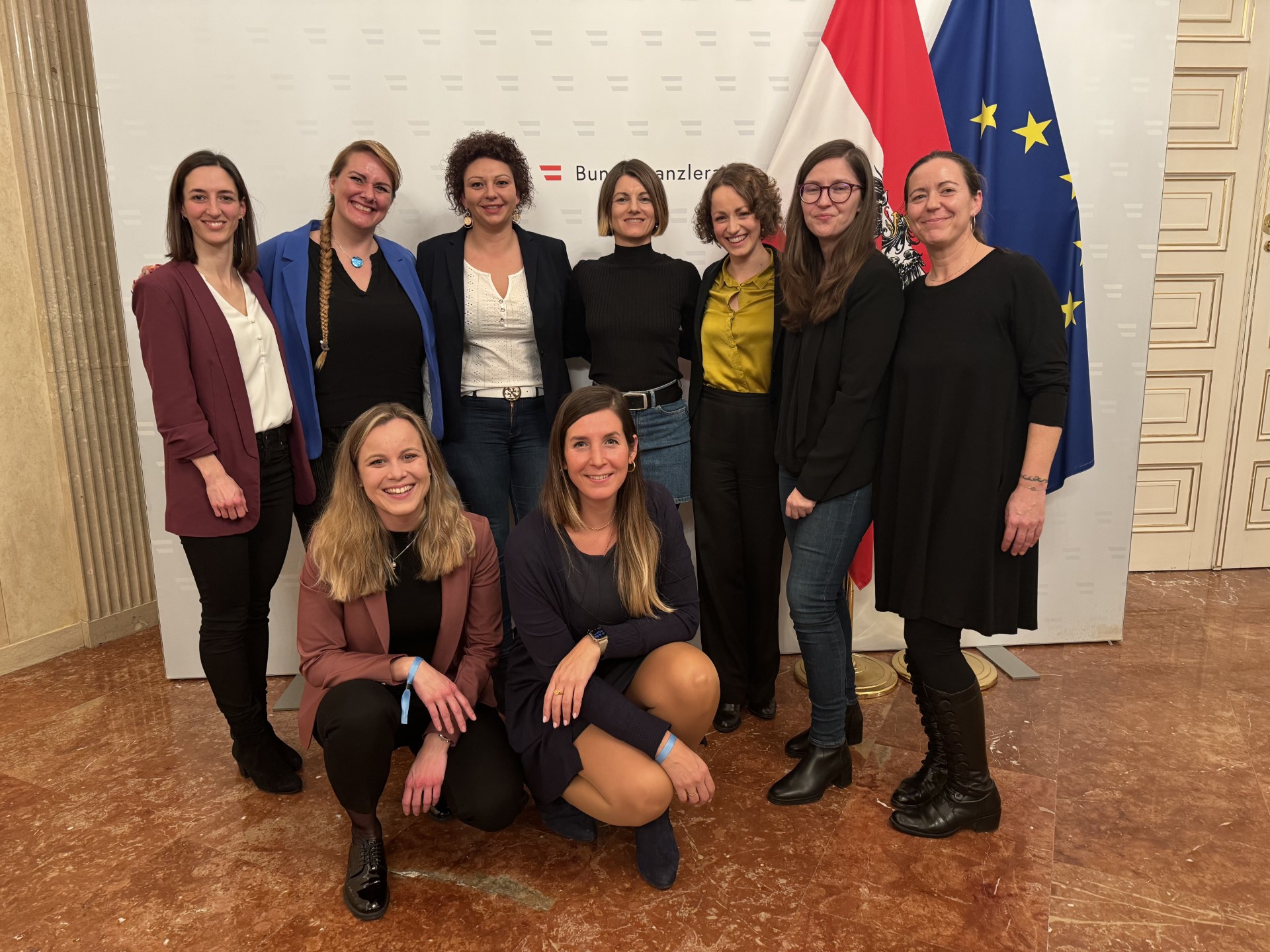
The moderation team, which unfortunately was not fully represented. Pictured (from left to right): Sabrina Bachmayr, Lorena Hoormann, Bianca Theuerweckl, Christine Hoffmann, Veronika Lubert, Bettina Kapfer, Tina Eitzenberger-Sedelmaier, Raphaela Plasch, Lisa Vavra. Not pictured: N. M. Feuerstein, Verena Sammer, Oliver Jeschonek, Sebastian Vavra., Janina Jakisic, Sonja Schumacher, Britta Seemann, Luzia Lagler.
Now, as a German woman in Austria, I've been recognized by the Chancellor. And for what, exactly? I'd say: because I did my job and enjoyed it. This is perhaps what's beautiful and simultaneously irritating about it. I was recognized for something that seemed „normal“ to me and that I love. I love working with groups and cooperating with wonderful colleagues. I was also fortunate to be selected as a cooperation partner for this great project, and my intuition strongly advised me to say yes to this project, and I followed it.
Alright, maybe not everything about it was luck and chance. Perhaps my expertise and experience with groups, scientific methods, and moderation also played a part, as did my empathy and my feel for people in situations. Perhaps also the feel for situations and my head, which usually creates pretty cool things. But still, now that I'm writing this, my Imposter Syndrome because from my perspective, there are so many people who deserve such an award long before me, because they do incredible things for our society.
What we were honored for: The "Corona Review Process"
This was a study in cooperation with the BKA, IHS, ÖAW, Statistics Austria, and Christine Hoffmann and her team. One of the largest social science projects carried out in Europe in 2023. A study that is unique so far across Europe: The examination of the pandemic with such scientific depth has not taken place anywhere else.
- The study objective: develop a deeper understanding of complex problem contexts, clarify what can be done better with a view to future crises, reappraisal of the Corona pandemic.
- The components of the study: Scientific case studies on different aspects of the pandemic, such as mandatory vaccination, home schooling, or increasing polarization, and a dialogue process with citizens. "Austria Speaks.
- My Role: As a facilitator in the dialogue process, create spaces in which citizens jointly develop recommendations for politics, science, the population, and the media.
I was allowed to moderate focus groups for one day each in three federal states. One each in Vienna, Styria, and Carinthia. The focus groups each consisted of 6-8 people. Besides myself, 4 other moderators were working on-site with their focus groups. A total of 5 focus groups were conducted per federal state. This resulted in recommendations and data gathered together with a total of 300 representatives of the Austrian population.
IIn these focus groups, our task was to create a space for exchange among the participants. Stories and experiences from the pandemic era should be exchanged with each other. Central to this are listening, perceiving other perspectives, and jointly developing visions and recommendations for the - hopefully never again occurring - case of a renewed crisis situation. The recommendations should be directed to 1) politicians, 2) scientists, 3) the media, and 4) the public, respectively.
What made it all so special and challenging from a moderation perspective was the fact that the composition of the groups was maximally heterogeneous. Both regarding sociodemographic data, as well as regarding attitudes towards and experiences with the pandemic and the measures. This exchange was always successful. Thus, without division and polarization, an exchange with moving moments and common results emerged.
Very personal, special moments
Special moments for me, for example, were when an elderly lady gave me a lavender-scented heart that she had sewn herself at the end of the day. Palm-sized with a loop for hanging. Then she said to me, "I sewed this from the bed linen my parents received as dowry 65 years ago when they got married. And I'd like to give it to you as thanks; today was truly a special experience." This heart hangs on my desk. Additionally, I also received a tip from a woman at the neighboring table about an outdoor hammock where one can sleep wonderfully in the woods, even if it's cool. I don't even remember how we got onto the topic; we didn't know each other. But for some unknown reason – I sometimes have the feeling – we humans seem to sense others with a similar "vibration.".
Some came to me at the end and said they were so happy and proud to have been a part of it. It was wonderful to be able to exchange ideas. That stories were told and listened to. That they could connect with people they would probably never meet in their everyday lives. That they learned a lot and fully endorsed the results they developed as a table. That they dared to present some of it to the other tables themselves. Phone numbers were sometimes exchanged. There were hugs, sometimes even tears. There was space for everything that being human brings with it. And I am very grateful that I was always able to hold this special space for the people at my table.
In any case, I am very grateful to have been a part of it. All these moments will always stay with me. And the coin will always remind me of it.
Dear Lorena, congratulations on this special award.
A very interesting post.
I wish you continued joy and success.
Warm regards from Anita.
Dear Anita,
Thank you very much 😀 Thanks also for your comment and thanks for reading 🙂
Have a wonderful day, and I wish you much joy and success as well!
Lorena
Dear Lorena, congratulations on participating in the study and, of course, on the award. This sounds very exciting and makes me curious. Can I find out more about the study and the results somewhere? Thanks for bringing me along to the Chancellery. Warm regards, Sylvia
Dear Sylvia,
There is a final report that can be downloaded for free at the following link: https://www.bundeskanzleramt.gv.at/dam/jcr:0668fa51-0122-4efe-a49e-6270a3a05840/82a_1_bei_NB.pdf
Perhaps I'll write a short summary about it on my blog soon.
The data will also feed into further research in the coming years (doctoral theses, etc.). This means that insights will occasionally be generated from the data. If I come across anything, I'd be happy to link it here!
Kindest regards,
Lorena