The Charter calls for active action towards the goal of „Health for All by the Year 2000“ and beyond. The participating states committed to taking active steps to achieve this goal. The focus was particularly on developing a health-promoting overall policy, creating health-promoting living environments, initiating community actions, strengthening personal skills, and reorienting health services. This is to be achieved through advocating for interests (advocating for health and equal opportunities), enabling and empowering people (strengthening health literacy and realizing health potential), and mediating and networking (within and outside the healthcare system). The 1986 Charter states:
"The conference requests the World Health Organization and all other international organizations to advocate for health promotion and to support their respective member countries in developing health promotion strategies and programs."
At the 30th World Health Assembly in Geneva in 1977, the following was decided:
„The primary social goal of governments and the WHO in the coming decades is to achieve a level of health for all citizens of the world by the year 2000 that will allow them to lead socially and economically productive lives.
This strategy, also
„Health for All 2000“ (HFA 2000), as it was called, was continuously developed in the following years. The Declaration of Alma-Ata in 1978 is central to this. It broadened the understanding of health policy, which had been strictly medically oriented up to that point. This applies to the understanding of which sectors are central to promoting health, as well as to the connection between social and economic factors as determinants of the possibility of maintaining health. The Declaration of Alma-Ata thus forms the basis of today's health promotion. In 1984, a WHO program for health promotion was established.
The The Ottawa Charter was adopted at the end of 1986 as part of the first International Conference on Health Promotion in Ottawa, Canada. The conference was attended by 240 participants from 35 countries, predominantly industrialized nations. Building upon the strategic objectives, it forms a Action program to achieve these health policy goals.it was the first health policy document and, according to one of its initiators
„ushered in the third health revolution. Then
sIt shifted the health policy focus: away from diseases as the central element of interest and towards prevention and the promotion of health in a holistic sense. Furthermore, it was quickly accepted at all levels (governments, state and non-state organizations) as a foundational document for health promotion, health education, health sciences, prevention, and "new public health.".
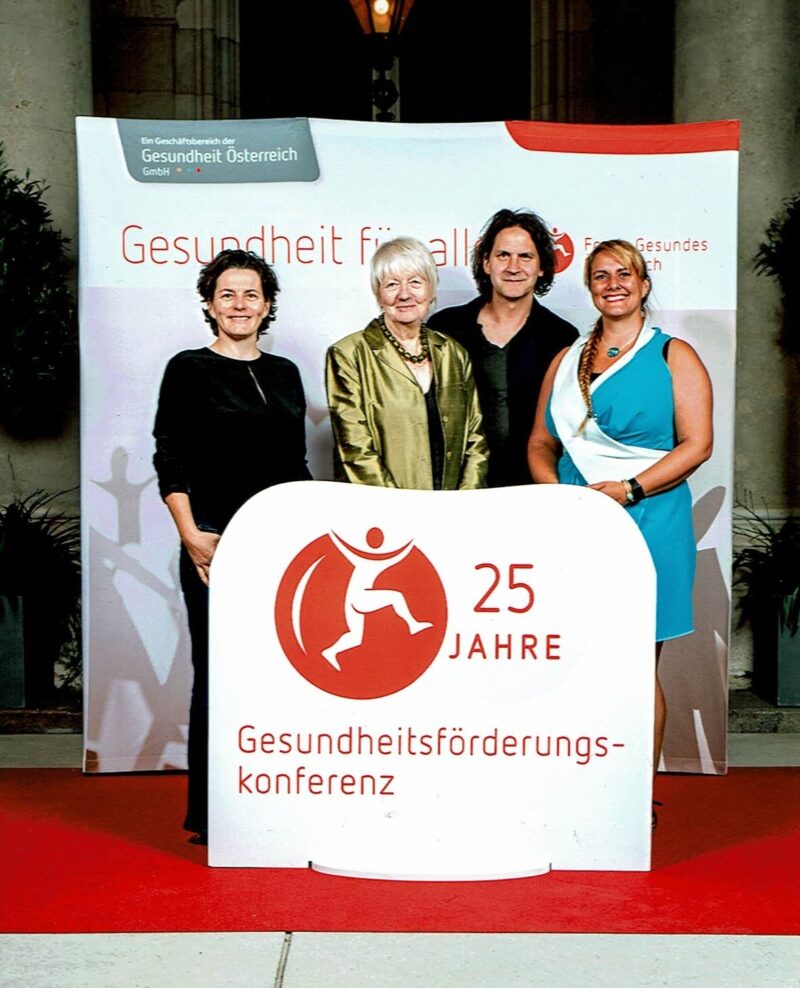
Fun fact: Last year, I had the opportunity to meet one of the authors of this charter at the celebration of the 25th anniversary of the FGÖ Health Promotion Conference at Vienna City Hall. Ilona Kickbusch. Here is the proof photo (she's the second from the left) 😉








0 Comments