
This is what's behind the term femicide
Femicide and Feminicide are terms that both describe the murder of women* by men because they are women*. The term "femicide" was coined in 1976 by sociologist Diana Russell. The term "feminicide" is an extension from 2005/2006 by anthropologist Marcela Lagarde. The added "ni" in the middle also incorporates the societal level, by which such murders of women* are not only structurally facilitated, but perpetrators are often not punished. (see also article by Franziska Pröll "Femicide or Feminicide - what is the difference?" from 06/15/2020). I will predominantly use the term femicide here, as this is currently the more common term for designating murders of women of this kind in Europe. The term feminicide is primarily used in Latin America (feminicidio) and has so far had little impact on European reporting.Femicides happen far away – or do they?
Femicide. That's something that happens „far away.“ Because it's unimaginable that intentional murder due to gender happens where I live and feel comfortable. Femicides. Not here. That's something from television, from the news from far away. Violence against women. Not here. Something that only exists elsewhere and not in „one's own country.“ Structurally caused violence against women*. Not here. Where everything is so orderly and „civilized.“ The gender-based killing of a woman. Not here. Where we have a functioning healthcare and social system. Murder because one belongs to the female sex or is read as a woman. Not here. In this open and „tolerant“ society. Femicide. Not in my neighborhood, not in my town, not in my country. Or?„Anyone who wants to can be whatever they want.“ „Everyone is responsible for themselves.“ „If you don't want to, you already have.“ „Women can be equal if they just want to be.“ „Self-inflicted suffering.“ „It's her own fault if she doesn't leave an abusive relationship.“ „I should be allowed to flirt.“ „Don't be so dramatic.“ „Stop being so hysterical.“ „Surely men are discriminated against these days.“ „Always this favoring of women.“ „Men are simply the stronger sex.“ „The motherly nature of female leadership benefits companies.“ „A real man doesn't show emotions.“ „Men need physical labor.“ „Men are muscular, tall, and strong.“ „A real man is a protector.“ „You have it easy, as a woman you get everything, you just have to use your charms.“
Not far away. Misogyny. The gender-based killing of a woman. Structurally enabled and conditioned violence against women. Murder due to the fact that one belongs to the female sex or is perceived as a woman. A very specific image of men and a „natural order of things.“ Femicide. The intentional murder due to gender. Discrimination and unequal treatment. Very close. Here. Right here.Femicides are not a result of the pandemic and lockdown
I need to clarify something here that is heard and read frequently at the moment. Currently, the pandemic is often cited as the reason for – as is often stated in the media – „increased violence against women.“ But this argument is far too simplistic. The violence was already there before. What leads to the escalation, what goes so far that a woman is murdered because a (usually) Cis-Mann The fact that she can no longer „own“ someone does not originate in March 2020. A femi(ni)cide does not „suddenly appear“ due to the pandemic, a lockdown, or too much stress. It is something that grows slowly and can thrive particularly well where the environmental conditions are right. A lot of time passes, because femi(ni)cides are not spontaneous acts. They have a history, which is made possible above all by structural advantages. Femi(ni)cides are murders in which a man kills a woman* because of her gender. In most of these murders, the perpetrators have already been reported for threats, stalking, or similar offenses. They are often partners or ex-partners, close relatives, or friends. Misogyny plays a role in this, the conviction that women* are "something" that men possess. That a woman* is less "valuable" than a man. Enough people and official bodies must look away or tolerate it. Enough men must think they „own“ "their" women* and must think it is okay to hit, rape, insult, and kill women*. Enough women* must perceive being treated sexistly and discriminatorily as normal. And this is not an individual problem, but a societal one. Femi(ni)cides do not happen suddenly or without signs, they are only the tip of the iceberg.Femicides are not a „new phenomenon“
I was recently asked if it was new that femicides happen. And I understand that assumption, because it is quite new that they are also named publicly and thus become visible. But no, that they happen, that is not new. It is, in fact, anything but new. But only recently has it been termed femicide and murder. Before, it was called "marital drama," "relationship drama," „family tragedy,“ or "unfortunate incident." But it is not an unfortunate incident. It is not an unfortunate incident when one person murders another. It is not a drama when a man kills a woman because she is a woman. It is not a play. It is not an act. It is murder. And it is a symptom of a society that ranks women, those perceived as women, and all those who are not "men," as inferior. This is exactly what used to be considered a private matter, and that wasn't long ago. If you pause for a moment now and think about how often you have read these terms – relationship drama, unfortunate incident, marital drama, family tragedy – in headlines, you will likely feel quite differently. Especially if you now realize that behind most of these headlines are actually femicides. Shocking, isn't it? But it happens. Femicides happen daily, and not just far away, neither spatially nor temporally, but right here and right now. Even if it is often still hidden or at least downplayed from public view. It happens. And only if we look and become active will it change.Numbers, Data, Facts on Femicides in Europe
When I say they are happening here and now, I'm not talking about „somewhere in Europe.“ For me, here and now is Vienna and Austria in the year 2021. Did you know that there were already more than 14 femicides in Austria in the first half of 2021? Did you know that Austria is the only EU country to have recorded more murders of women* than of men several times in a row? Did you know, that in 2020, 31 femicides were recorded in Austria, and 39 the year beforeBut femicides are not just a current issue in Austria. Did you know that in mid-June 2021, the sad headline in Spain read: "at least 12 femicides in 4 weeks"? Or do you know how many femicides there have been in Germany in recent years, according to criminal statistics? According to Eurostat, in 2018, 204 women* were intentionally killed by their partners or ex-partners, family members, or relatives, and in 2017, 231 women* were intentionally killed by their partners or ex-partners, family members, or relatives..Sea latest survey by the European Union Agency for Fundamental Rights (FRA) in the last Each year, over 1/4 of women* are victims of harassment. However, 68% of the victims do not report the incident to the police. 83% of the women* also stated that they feel they have to protect themselves by limiting their range of movement and the people in their social circle. Alarming, isn’t it? 3 out of 4 women* feel unsafe and feel they have to take additional precautions to ensure their safety.-
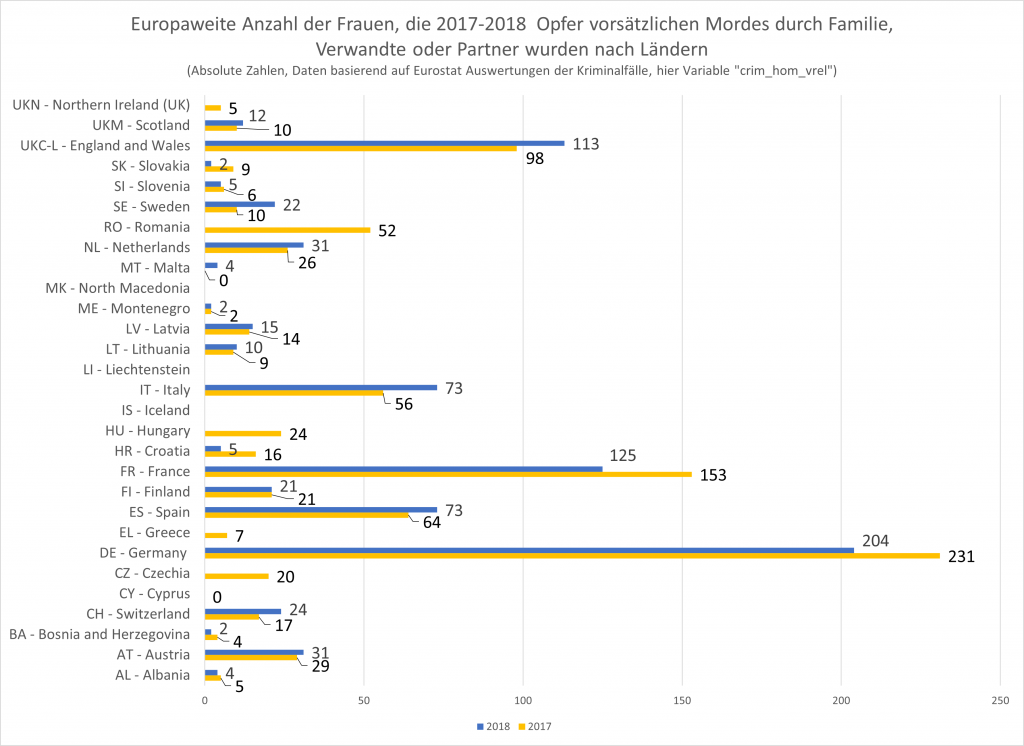
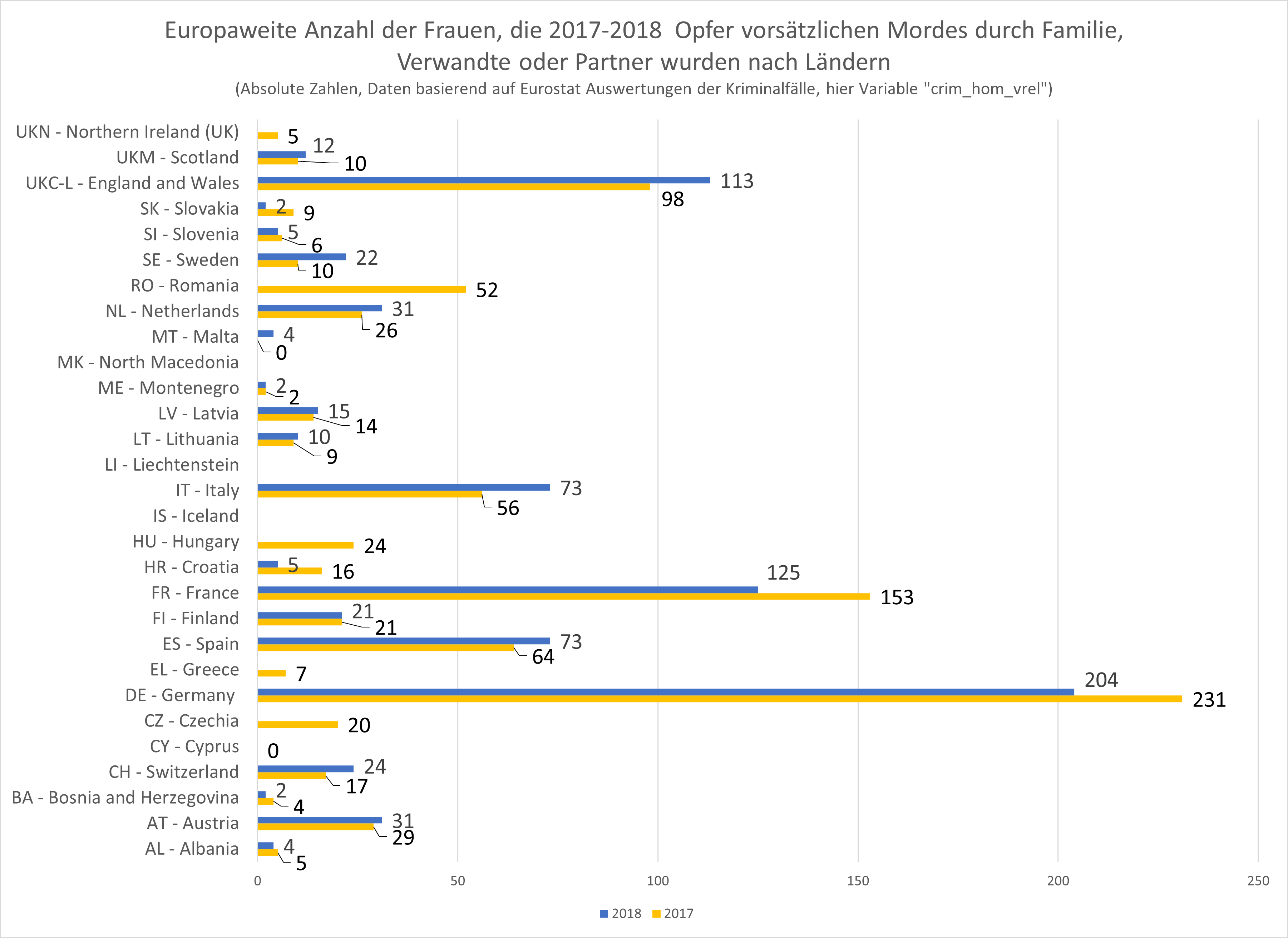
- This graphic shows the absolute number of women in Europe who were victims of homicide in 2017 and 2018. A large portion of these are classified as femicide. Germany leads in absolute numbers, sadly.
-
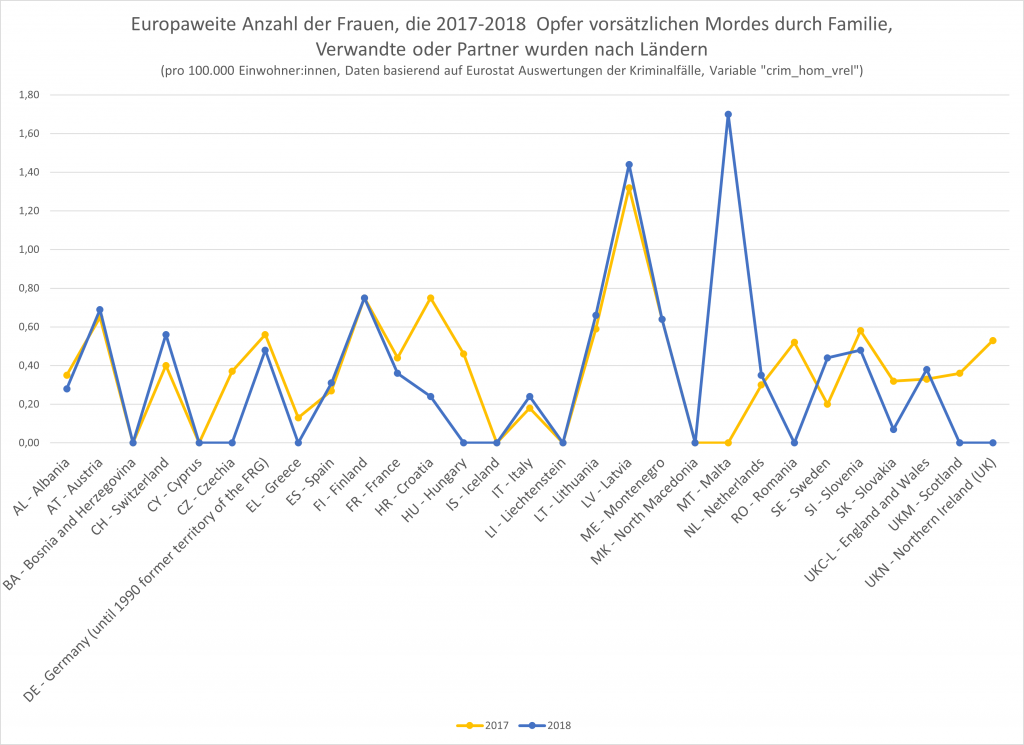
- This second chart shows the number extrapolated to the value per 100,000 inhabitants of the respective country.

What do femicides actually have to do with my profession?
First of all, I am a woman and a feminist, and I work as an independent business consultant in an industry that is still very classically „male-white“ dominated. I am repeatedly made aware of this in various situations. For example, a consultant "caringly" points out to me at networking events whether I have noticed it, that I drew a wrong line on the logo on the cards, pens, and homepage. Or even that I hear "classic" terms like „sweetie,“ „doll,“ or the suggestion to use my charms to achieve something. All of this has one thing in common: it's based on a view of women that classifies women as inferior. And no, fortunately, not all male colleagues are like that. I surround myself with people who support my values, and there are quite a lot of them. But the variant described here also exists. And it's not that rare.
And because I am convinced that every step in the right direction is important, I have decided to stand up for my fundamental values not only privately but also professionally. Instead of accepting things as they are, I have decided to make certain fundamental values my mission, even in my professional life. Because I am convinced that we can all contribute, both privately and professionally, to ensuring that no woman is discriminated against or murdered simply because she is a woman. I am convinced that together, in diversity and cooperation, with equality and equal opportunity, we can achieve much more and live better than alone, in conflict and competition. This conviction also flows into my coaching, training, and consulting, but above all into decisions for or against collaborations and client relationships. I do not want to work with people for whom equal opportunity, diversity, and equality are anathema. Anyone who is open to doing something in this direction, who is open to these topics, is welcome to work with me as a client or cooperation partner.Structurally can be improved
In our society, of course, legislation and the state in particular have the power to initiate a major push for change.- For example, it would be important to create structures that intervene preemptively and prevent escalation to murder. There are already many studies, concepts, institutions, and possibilities in this area, but often there is a lack of appropriate prioritization of public funds.
- Campaigns are needed to raise awareness that violence against women occurs, that victims are not alone, and to show what support services these women can access safely. These campaigns should also raise awareness about how people can recognize when someone has become a victim of violence and what to do in such situations.
- Furthermore, topics such as victim protection and violence against women should also be increasingly integrated into the training of professions that directly come into contact with these issues. Because this is still not the norm. Professions would include, for example, police officers, lawyers, judges, nurses, doctors, and many more.
- But it's not just victims of violence who need more support services, but also potential perpetrators, so that they have the opportunity to receive accessible help in a timely manner.
- The duration of proceedings and the possibilities for prosecution and monitoring would also have to be improved. 6 months until a decision on the initiation or cessation of proceedings by the public prosecutor's office against an indicted offender, during which a potentially dangerous man can continue to move freely, is clearly too long.
- Furthermore, up-to-date data, statistics, analyses, and more studies are needed. While writing this article, I am once again realizing how difficult it is to find data and statistics on this topic. This is also part of the problem: How can something be made visible if the data for it is not available, for example, because a country does not participate in a survey or the crime statistics are not available? Or because a murder is not even documented as the murder of a woman or femicide? And what do you think, emotionally, about how many attempted femicides or how much violence against women there currently is that has not yet appeared in any statistics or newspaper article? How many perpetrators do you think are still out there freely?
What each and every person can do for a future without femicides
Such a structural impetus can only flow in the right direction and make waves where it is picked up and supported. And sometimes it only gets going when enough people are interested in the topic and actively engage with it. So, in my opinion, it takes much more than „just“ a structural framework. This framework must be filled and, indeed, lived. And that at a societal level. This iceberg tip of femi(ni)cide and ultimately the entire iceberg will only disappear if we look, if change is actively brought about. Because at all levels, preventive measures can be taken to prevent the worst. And this can be done by every single person, both in their private and professional lives. Each and every one of us can help to make this iceberg melt, and it doesn't take much. If each of us takes the following two aspects to heart, a lot will be set in motion:- Everyone can reflect on their own language use and pay attention to the words they use. This doesn't just mean gender-neutral language. It becomes really interesting when we look at the clichés, sayings, wordplay, comparisons, and imagery that we use or hear every day. „Words can be like tiny arsenic pills. They are swallowed unnoticed, they seem to have no effect, and after some time the poisonous effect is there.“Victor KlempererWhy not use the power of words for positive development?
- Each of us spends a large part of our lives in a work context and with various people within the social system of „the company.“ Here too, each individual can do something. As soon as we sharpen our own senses to this topic, we can make others aware of it. We can initiate discussions and encourage new ways of thinking. The great thing about the work context is that the company as a whole then has an even greater leverage to raise awareness and advocate for equality and equal opportunities, diversity, and cooperation. This can also extend beyond the company's borders.

Thank you, Lorena, for this important and enlightening text. The topic of femi(ni)cide is definitely one that needs much more public attention. Because, as you say, it is the sad tip of the iceberg of a structural problem. And it is so important to show that inequality leads to violence. Against women, but not only.
Regarding language use, I also find the common use of the passive voice when reporting femicides an important point that we should be aware of: "Woman murdered in domestic dispute." Instead of: "Man murdered woman." With the use of the passive voice, the focus is on the woman as the victim, but the focus should be on the perpetrator and his act. And this act must absolutely be called by its name.
Dear Yvonne, thank you very much for your encouraging comment!
And thank you for the important addition regarding language use and who is suggested to be the active party in reporting. You are absolutely right, the passive voice is often used here, and it should definitely be made even more explicit and clear that the perpetrator is the active party. Additionally, it would be important to remove all subordinate clauses that appear to be downplaying the act. For example, it is currently common to point out the perpetrator's nationality. Or that the perpetrator claims they had no intention of murder, if the victim survives (this was recently reported in the media in a case in Graz). This distracts from the actual problem, because it's not about an „imported“ problem, which is often where the discussion leads. This happens in both social media and political debates. Conscious language use and differentiated reporting along the essential facts would be incredibly important on this topic. Thank you for picking up on and addressing this important aspect, which is often overlooked 🙂