The concept of work in a social context
„First the work, then the pleasure“ „If you can party, you can also work“ „No pain, no gain“ „He who rests, rusts“Who hasn't heard them, the wonderful sayings that we have been passing on socially for decades. All these sayings have one thing in common, namely the idea that there is a certain way in which life works and how much of our time we can freely determine and to what extent. The idea that work is not inherently meaningful, let alone meaningful for each individual, also resonates everywhere. Work is what we live or what we do in order to live. The things that are close to our hearts, that we find meaningful for us as human beings and that we use to create meaning are often located more in our leisure time. _____
The cornerstones of the current concept of „work“
365 days a year, divided into months and work weeks, as well as weekends. 5 days a week are intended for work, 2 days a week are (in most cases) available for non-work-related matters. 40 hours or more are dedicated to work on 5 or more workdays; the rest is for everything else. In our work concept, the workday is conceptually considered to be 8 hours as a standard unit – classically and predominantly viewed as „normal,“ starting in the morning and ending in the afternoon. These are the starting points for all further specifications of our work concept: Below this is minor employment or part-time work, above this is doing overtime, and at other times shift work, late, and night shifts. There is also a primary job to which we dedicate the larger part of our time, and sometimes a secondary occupation, unpaid volunteer work, or unpaid care work, in which we also achieve something, but are not provided with financial resources for it according to our work concept.The cornerstones of our idea of “leisure”
In our working concept, leisure is understood as our "free time," the time that is freely available to us after work is done. At first glance, it's pretty great: 8 hours of work in a 24-hour working day means a brilliant 16 hours of free time! But wait: can we really use these 16 hours freely? Not really. We should also sleep, ideally around 8 hours, so that leaves 8 hours that we can divide up freely. That's also a pretty good deal: 8 hours work, 8 hours free time. But wait a minute. Work, sleep, self-care, care work, relaxation, hobbies... Phew, quite a program that is predominantly filled with performance activities, especially when a large part of our energy has already gone into work. This means that we don't usually have any real freedom to organize our time, especially as the framework conditions largely dictate when we can do what (shopping, sports activities, etc.). So our understanding of "leisure" is actually misunderstood if it encompasses everything that isn't "work." The term is misleading., because this time is not really free. It is the time we use for ourselves and those around us. Usually, however, more for those around us and less for ourselves. And often with additional benefits, even if they are not compensated financially. _____What our current work concept is based on
How long has the idea of work and leisure existed? And how did it develop? This question is one that I always address with students on the subject of organization and change. This is because it is very revealing to learn about the basis on which our work concept is built. Because this basis also limits the possibilities to a certain extent and provides a direction, a framework. Ask yourself the question: How many truly new and groundbreaking things are possible if the foundations look like this?.Increased efficiency in the Taylor system
With the aim of optimizing efficiency and performance in production, the focus was on specialization, standardization and formalization, the classic logic of a factory from the industrialization era (keyword „Taylor System“).„A person is like a part of a machine; He is lazy, selfish; he is only interested in material goods; he must be controlled and externally motivated.“ (Frederic Taylor)Henry Ford in particular, who founded the Ford Motor Company in 1903, implemented and further optimized this machine logic in an ideal form thanks to flow production, a high degree of standardization and the disassembly of work processes. This „Fordism“ led to an unprecedented increase in productivity. Workers were primarily motivated by higher wages.
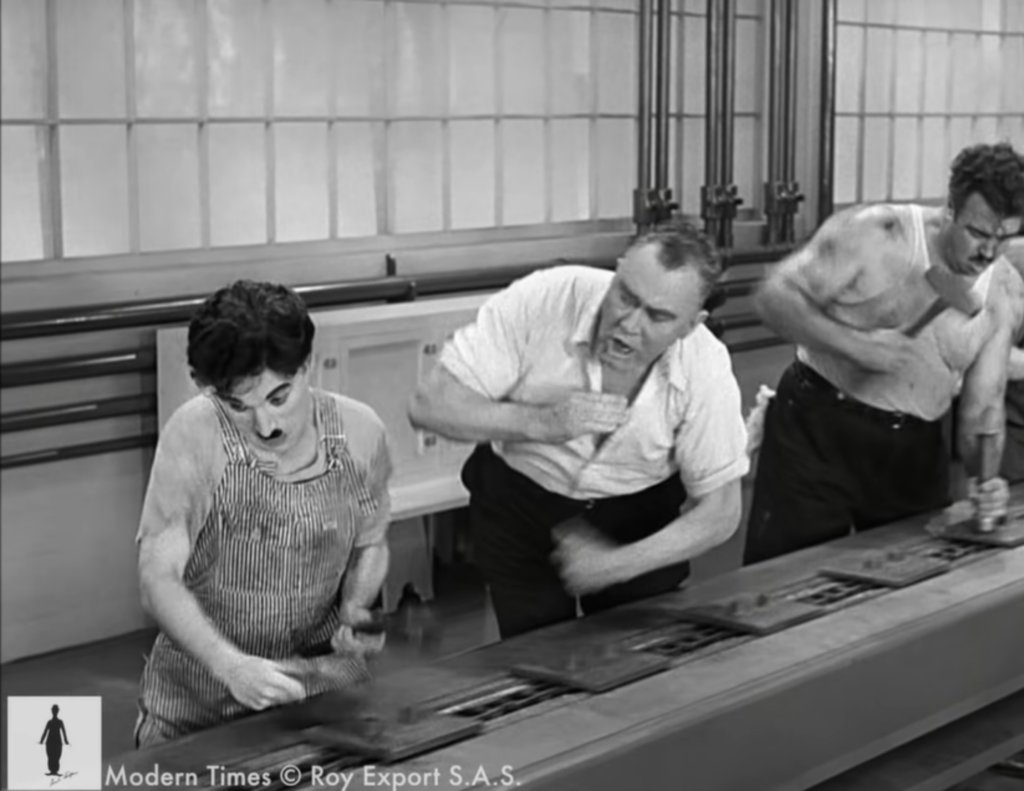
Assembly line work: The origin of our work concepts. Here is a screenshot from Charlie Chaplin's "Modern Times" - a confrontation with the understanding of a human being as part of a machine as a reality of working conditions at the time.
Motivation can be increased by social factors
Building on the aforementioned foundations and in pursuit of further efficiency gains, the „Hawthorne Experiments“ were conducted from 1927-1932 with the guiding question: „How can employees be motivated to achieve high performance?“ These experiments established the Human Relations Approach, which remains the basis of our approach to work today. The underlying realization is that social relationships are highly relevant to human motivation. This can be deliberately influenced: If the social environment and the work are perceived positively (supervisor's behavior, trust, material incentives), job satisfaction increases, which in turn leads to higher productivity and greater work output.„Man is a social being; as a member of a group, he develops a common behavior towards the environment; the individual is merely a variable in explaining behavior." (Elton Mayo)So, what we consider normal today emerged from a logic of increasing efficiency and productivity. Job satisfaction, as an interesting factor, was also included accordingly. And these foundations are still effective today: we continue to optimize work cultures and environments so that work can be accomplished, the core business can be handled well and efficiently, and everyone gives their best for it. And there are undoubtedly many brilliant achievements here. Nevertheless, they operate within this traditional framework.
We have long since made the best possible use of the existing work concept
I am convinced that we have currently reached a point – similar to Henry Ford back then – where we have gotten the very best out of what the foundation it is built upon allows. Because: How much optimization and change towards a „new“ work concept, in accordance with current societal conditions, is actually possible? All new work concepts, corporate approaches, ideas for work organization, dissolving hierarchies, and flexible processes have their limits in their potential for change and development, which are dictated by the framework on which they are built. Furthermore, we as a society have evolved, and the context of work is different than it was then. We have different needs, a much higher awareness of what is good for us and what isn't. There are new crises and challenges to overcome, especially the climate crisis. Challenges that we can no longer „manage“ in our „leisure time,“ but for which overcoming requires different foundations and logics, indeed a completely new way of "doing."Quo vadis, „work“?
It is time for us to not only develop our idea of work further, but to completely rethink it. The current challenges for employees and employers, for companies and the workforce, can only be seized as an opportunity if we reinvent ourselves. Companies are currently suffering particularly from a shortage of skilled workers, which will intensify in the coming years, as the retirement wave of the so-called „Baby Boomers“ is about to begin. Many experts will be leaving the labor market, having embodied a work ethic that is no longer prevalent today. The understanding of work is changing and companies in particular cannot meet these changes effectively with traditional methods. Of course, it would also be possible to keep passing the hot responsibility potato around„But first... the politicians/the biggest industries/other countries would have to...“. But then nothing would change. Or to put it another way: we would leave it to chance in which direction we or „it“ would change. This idea is also somehow unsexy, isn't it? And yes, of course, this change is also one that requires us to let go of what we have grown to love and become accustomed to. The one that hurts, the one that requires effort and in the meantime perhaps even - when the new is not yet there and the old is no longer there - a little chaos. But better a chaos that can be actively influenced and a change to a future that suits the new conditions than one that we have to deal with reactively. Or what do you think? _____What is needed to reinvent the concept of work
The concepts and new models are there, it's not about having to develop or invent something new. It's about having the courage to let go and reinvent yourself. As a company, as a society, as an economy. And it's about establishing new metrics that open up a new space of possibilities. A new space of possibilities where the cards are reshuffled and responsibility is shared, for all of us. Because one thing is certain: the way things are now, it's no longer working. We see this in the skilled labor shortage, stagflation, increased pandemics and wars, the climate crisis, a widening gap between those who have everything and those who have nothing, growing inequalities of opportunity, and growing child poverty. And this is happening despite all adaptations of the existing system. The necessary change will not work „top down“ – neither at the societal nor at the corporate level. It is a change that only we can bring about together by deciding to use our Self-Efficacy© for ourselves and a better future. Changing the concept of work as it exists now can only happen if awareness is raised and people are empowered to perceive their own needs and those of others, to take them on board, to work with them and to include the wider context. And this is already happening, even if we are often not so aware of it. I am myself a consultant for corporate health promotion, healthy work cultures, and I support people in their personal development through coaching and training. A central desire is always to find one's own way of working and to integrate it optimally into one's own work – as an individual, team, or company. This involves a huge variety of factors that can influence our well-being (mental, physical and social) both at home and at work. My clients are usually concerned with the desire to increase their own well-being and at the same time the sense of purpose and their self-effectiveness. It is about thinking ahead, understanding one's own needs and priorities. Firstly, in the context of the existing situation, to become aware of the limits of the possibilities. Then it is also about getting back into action yourself and actively shaping your environment. It's time for something new. Let's understand work as a contribution to joint, socially and ecologically compatible action. As a work concept in which not everyone is squeezed into predetermined paths, but in which diversity is lived in all directions and potential is called upon. And in a way that enables everyone to use their energy for what is close to their heart and thus to develop their optimal SelbstwirkKRAFT ®. Because we have reached a point where further development in the conventional way has reached its limit. And I plead for the The courage to completely reinvent „work“.If you would like to take a closer look at your SelbstwirkKRAFT© and find out in which direction you would like to focus it, then beech gladly a non-binding initial consultation with me or call me and we'll see how I could accompany you on this path, for example as part of my SelbstwirkKRAFT© coaching package.

0 Comments