
Leadership rarely begins where we expect it. Not in the meeting room, not in the feedback session, not in the strategic decision.
It begins more quietly – in the internal assessment of a situation, even before a word is spoken. While we discuss, analyze, or react, something is already at play: an attitude, an implicit understanding of what is actually happening here.
This inner framework often remains invisible, yet it shapes how we lead, how we understand responsibility, and what we believe is possible. Therefore, whoever wants to understand leadership must take a step back. Not looking at behavior first, but at what precedes it.
This article is the second of seven entries in the series „Rethinking Leadership.“. It forms the starting point for a perspective on leadership that doesn't begin with behavior, but with the internal and organizational dynamics from which leadership emerges.
What precedes leadership
Content: Before leadership becomes visible, an attitude is already at work, from which situations are perceived and categorized.
What is understood by leadership is not self-evident. When leadership is discussed, it often quickly turns to behavior, decisions, communication, and presence. To what someone does, says, or omits in discussions, feedback sessions, and evaluations. But on reflection about many leadership situations, it becomes clear: before leadership becomes visible, it has already happened internally. As an attitude – the way we look at situations. It strongly influences what currently appears as a problem, how we see the people in the room, what seems possible or impossible to us – usually unconsciously. Within the self-efficacy possibility space of leadership, this attitude forms the outer framework. It encompasses logic, focus, and mode. It is not spectacular, methodical, or technical, and yet it determines how leadership is exercised.
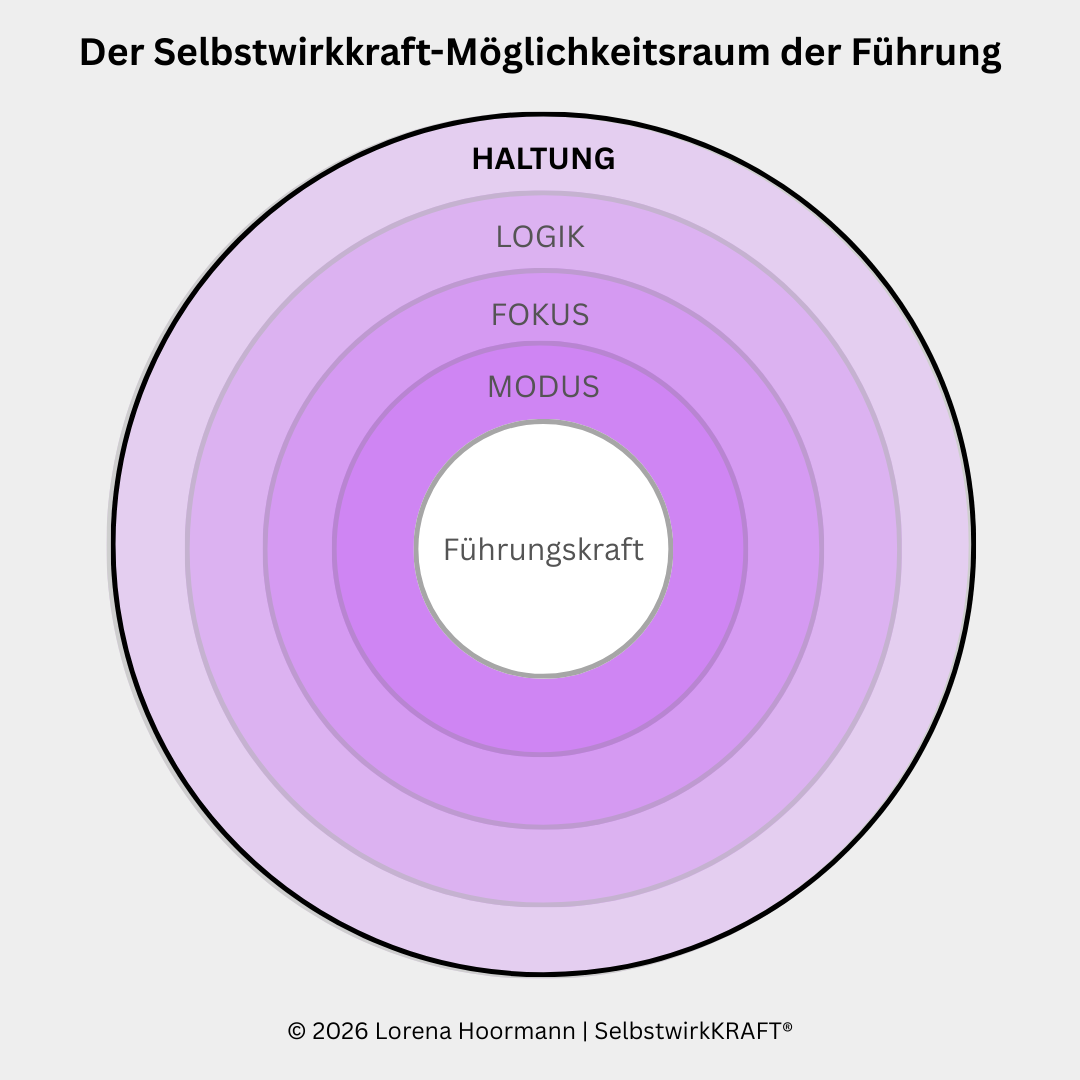
The Self-Agentic Power Possibility Space of Leadership: An Orientation Map Showing How Stance, Logic, Focus, and Modus Shape Leadership Action.
2. Attitude as a Framework for Action
Attitude forms the inner framework through which situations are interpreted and decisions are prepared.
Attitude cannot be "applied." It is not a method, a tool, or a concept that can be used. It manifests indirectly: in what someone considers important, what is identified as the cause, or where attention falls – and what is overlooked. Like a pair of glasses you wear without constantly noticing them.
In this context, self-reflective attitudes within organizations encounter systemic limits, and conversely, dominant organizational cultures shape these attitudes. These internal frameworks become particularly evident under pressure. When time is short, expectations are high, and decisions must be made quickly, familiar interpretations come into play. This is not due to negligence, but to the need for orientation. What has proven effective appears plausible. Leadership then often happens automatically – less as a conscious choice, more as an implicit reaction.
3. Different Ways of Understanding Leadership
Content: Different attitudes direct attention to different aspects of leadership, making certain perspectives more likely than others.
Some attitudes focus attention on connections. They inquire about patterns, interactions, and system dynamics. Leadership then appears less as a personal trait and more as part of a larger framework. This can be a relief—and at the same time raise the question of where action begins within this framework.
Other attitudes turn the gaze inward. They are interested in uncertainty, being overwhelmed, and unspoken tensions. Leadership becomes relationship work. This creates closeness and understanding, and at the same time can cause structural conditions to be overlooked.
Still other attitudes emphasize possibilities. They draw attention to resources, to what works despite everything, to small shifts that bring about change. In such moments, energy and room for maneuver arise, yet in retrospect, it sometimes shows that this movement came too early, that there was first a need for space for the difficult.
And finally, there are attitudes that place leadership within larger contexts – organizational, societal, cultural. Suddenly, it becomes apparent that much of what is experienced as personal failure is structurally inherent. This can be freeing and sobering at the same time.
None of these ways of looking are neutral. Each opens up certain perspectives and closes off others. Each makes certain decisions more likely and others less likely.
4. Another Beginning of Leadership
Leadership often begins with recognizing one's own attitude and the perspective from which situations are viewed.
Perhaps leadership doesn't start with the question of how to do things better. But rather, with the awareness of where we are looking from. Which stance is effective and what becomes possible or is overlooked as a result. This perception doesn't immediately change structures, but it opens a space of possibility, it shifts something and creates an intermediate space where leadership can not only be practiced but also examined. And often, that is precisely the beginning. It's not behavior that shapes leadership first, but the attitude from which situations are assessed, usually long before they can be consciously articulated.
5. Essence
Leadership doesn't begin with visible actions, but with the mindset from which situations are assessed. This mindset shapes what appears as a problem, what seems possible, and how responsibility is understood.
The following contributions in this series will therefore look at different dimensions of leadership step by step: attitude, logic, focus, and mode – and how their interplay shapes leadership in everyday life.
6. For your own reflection
Perhaps it is worth taking a moment to pause and engage with the following reflections – entirely without pressure:
- From what attitude do I interpret situations when I come under pressure?
- Where do I locate causes within the individual, within the system, within the circumstances?
- What perspective seems obvious to me?
- And which ones do I avoid?
The next article will be about logic., structuring leadership – sometimes quietly, sometimes dominantly – and often shaping decisions more strongly than good intentions might suggest.
7. When reflection is to become design
The question about the stance behind leadership rarely remains abstract. In coaching sessions and workshops, it becomes repeatedly clear how strongly decisions are already shaped before visible action – through implicit assumptions, through habitual interpretations, through inner images of what is „right“ or „professional.“ And how much shifts when these inner frameworks become conscious.
This is exactly where I pick up in my work:
- Leadership coaching is about understanding one's own attitude and its impact – especially where it becomes automatic under pressure. We clarify which internal classifications guide actions, which of them strengthen, and where new perspectives become possible.
- In workshops with leadership teams – for example, on healthy leadership or in the context of change management – we work to make different mindsets within the system visible. Not to evaluate them, but to collectively reflect on their impact on decisions, culture, and collaboration.
- And in the field of corporate health promotion, it becomes clear how much collective attitudes shape the experience of work – and how important it is to consciously shape these if organizations want to remain healthy in the long term.
If you noticed that certain situations were recognizable while reading, or that the topic touched you emotionally, then perhaps a closer look together would be worthwhile.
Sometimes change doesn't start with a new method, but with a more conscious awareness of the attitude from which one leads. If you'd like to explore this perspective together, feel free to sign up for a no-obligation introductory meeting at info@hoormann-consult.com.
Series: Rethinking Leadership


Dear Lorena,
This article offers a completely new perspective on leadership, looking at the mindset that precedes what we generally understand as leadership. It's definitely worth taking a closer look and, as you say, stepping back. In any case, I've realized that leadership influences far more than we initially think. Thanks for this article.
Greetings
Annette
Dear Anette,
Gladly! This step back and taking a close look are often real game changers and regularly provide "aha!" moments in my consultations and training sessions as well.
Best regards,
Lorena