
Leadership is often described as a professional role. As a function on the organizational chart. As a task with clearly defined expectations. Throughout this series, it has become clear how much leadership is Posture, Logic, Focus and Modus is shaped. And yet, a layer remains that cannot be fully mapped in models or structures. Because leadership never happens abstractly. It always happens through a concrete person.
This article is the sixth of seven in the series „Rethinking Leadership.“. I'm vThe previous article was about the topic of which mode you lead in. This article now turns its gaze decidedly to the personal in leadership: to experiences, limits, influences, and inner themes that often have a stronger effect than methods or concepts. Not as a weakness, but as a reality and as part of the space of possibilities in which leadership arises. Perhaps it is precisely here that it becomes clear why leadership is never just professional.
If something remains inconsistent in the leadership
Content: Passage about difficult-to-explain leadership situations
In many retrospectives of leadership situations, a moment eventually arises that is difficult to pinpoint. Not a factual error. Not a wrong decision in the classic sense. And yet, a feeling of discord remains. Something felt heavy. Too close. Too much. Or vice versa: unexpectedly distant, cold, cut off.
This moment is often rationalized in retrospect. With references to frameworks, roles, and expectations. And yet, beneath these explanations often lies something else. Something personal. Something that isn't in job descriptions, but still shapes leadership.
From the very beginning of the series, it became clear that leadership always happens through a person. And precisely here, it becomes visible how much the personal is part of leadership – not as a disturbance, but as a factor of effectiveness.
2. Leaders are not neutral
Content: Personal experiences, influences, and sensitivities always impact leadership.
No matter how much organizations try to define leadership as a role, a function, or a task: in practice, it repeatedly becomes clear that leaders do not act neutrally. They always bring themselves into it (surprising thought?). Their experiences, limitations, influences, and sensitivities.
Some situations touch on old issues. Others leave one surprisingly cold. Some demands are met as a matter of course, while others take disproportionately much energy. Not because someone is unsuitable. But because personal issues resonate.
This is often overlooked in many leadership discussions. Or marked as a weakness. Yet, it's simply reality.
3. The personal is the foundation of leadership
Content: Attitude, logic, focus, and mode always work through the person of the leader.
In the self-efficacy possibility space of leadership, the leader is at the center. Not as an idealized figure, but as a real person with their own inner life.
The personal is not an additional layer to be considered „on top of everything else“ here. It is the foundation upon which all other layers become effective. Attitude, logic, focus, and mode always act through the person.
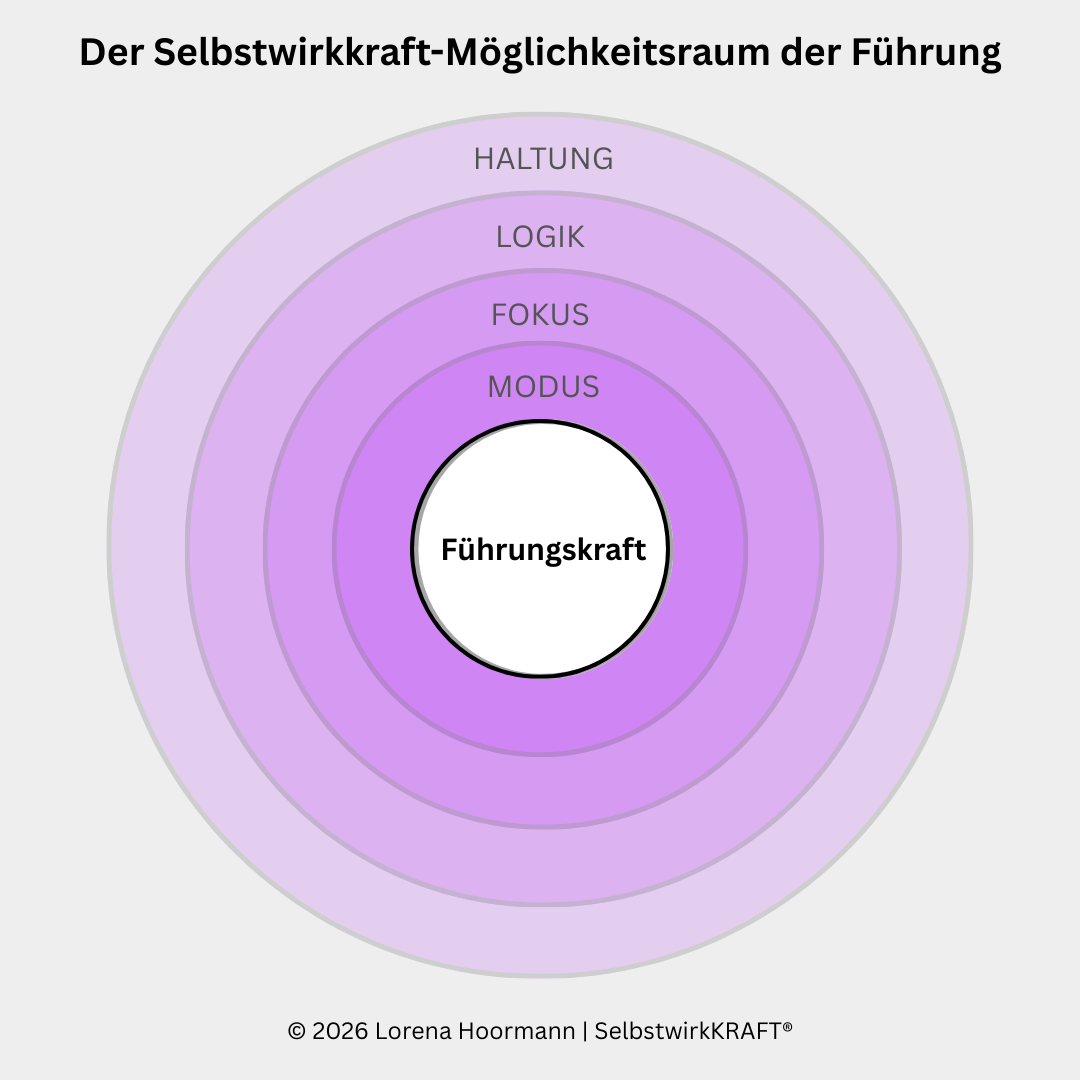
The Self-Agentic Power Possibility Space of Leadership: An Orientation Map Showing How Stance, Logic, Focus, and Modus Shape Leadership Action.
Can I set boundaries.
Whether I can bear responsibility well.
Whether closeness is sustainable for me or quickly becomes too much.
Whether conflicts energize or paralyze me.
Personal experiences shape how situations are interpreted. And these interpretations directly influence leadership, often faster than they can be consciously reflected upon.
4. When Leadership Becomes Cognitively or Emotionally Expensive
Content: Certain leadership situations consume a disproportionate amount of energy.
In many conversations with executives, a recurring pattern emerges: certain situations consume a disproportionate amount of energy. They are cognitively expensive. Emotionally draining. Often invisible from the outside, but very present internally.
This can be related to biographical experiences. To neurodivergent processing styles. To internal drivers. To unresolved hurts. Or simply to current overwhelm.
The important thing is: these costs are not a sign of incompetence. They are an indication. Of limits. Of fit. Of necessary self-care.
Leadership in the appropriate mode determines whether these costs remain sustainable or increase permanently.
5. Setting boundaries is one of the most difficult leadership tasks.
Content: Difficulties with setting boundaries are often related to loyalties and internal concepts of responsibility.
A central personal theme in leadership is setting boundaries. What belongs to my role – and what doesn't? What do I take personally – and what do I leave with the other person? Where does responsibility end, where does overwhelm begin?
Boundary setting is often perceived as an individual deficit, something one needs to „learn“ or „get better at.“ However, in hindsight, a lack of boundary setting often has less to do with insufficient technique and more to do with internal loyalties, fear of rejection, or deeply ingrained notions of responsibility. Leadership here is not made easier by more methods, but by more awareness.
Especially in contexts that are meaningful or highly responsible, leaders struggle to take their own well-being seriously. Self-protection quickly appears selfish, unprofessional, or unfit for leadership. Looking back at many processes, it becomes clear that leadership that constantly pushes beyond its own limits loses quality. Decisions become narrower. Reactions quicker. Focus narrows. Not out of ill will, but from exhaustion.
Self-efficacy in leadership doesn't arise from overextending oneself, but from alignment.
6. A More Mature Look at Leadership
Content: Good leadership arises where personal resilience is taken seriously.
When the personal is understood not as a disruptive factor, but as part of the space of possibility, something essential shifts. Leadership is no longer seen solely as a matter of competence or attitude, but also as a matter of resilience.
Not everything that is possible is equally bearable for every person. Not every leadership style fits every phase of life. And not every organization allows for the same form of self-efficacy.
This insight is a relief. And it opens new spaces for conscious design.
Executives never act solely out of posture, logic, focus, or mode. They act as human beings. With everything they bring.
Perhaps a more mature approach to leadership begins right here. Not with the question of how one could lead even better. But with an honest perception of what one can carry and what one cannot.
Essence
Leadership never happens solely in a professional role.
It always happens through a specific person – with experiences, influences, limitations, and inner themes.
These personal factors are not a hindrance to leadership.
You determine how responsibility is handled, which situations are draining, and which freedoms of action are actually utilized.
A mature perspective on leadership therefore does not begin with new methods.
But in the honest perception of one's own load-bearing capacity.
Self-efficacy arises there.
8. For self-reflection
Perhaps it's worth pausing for a moment:
What situations affect me more than I want to show?
Where will I be activated faster – or get distanced faster?
Which topics consume a disproportionate amount of my energy?
Which of my personal boundaries do I regularly ignore in the name of professionalism?
Where do I confuse loyalty with overexertion?
And what would change if I took my own load-bearing capacity seriously?
Sometimes leadership doesn't start with more competence, but with more honesty with yourself.
9. When reflection is to become design
Taking the personal aspect of leadership seriously doesn't remain abstract. In coaching, it repeatedly becomes clear how relieving it is to consciously consider one's own influences, limitations, and drivers – not as a deficit, but as part of leadership reality.
This is precisely where I'm starting in my work.
In leadership coaching, we reflect on personal patterns, boundaries, and sources of energy – especially where leadership becomes permanently too costly.
In workshops with leadership teams – for example, on healthy leadership or in the context of change management – we make visible how individual issues influence collective dynamics.
And within the framework of corporate health promotion, it becomes clear how much sustainable leadership depends on personal resilience not being overlooked.
If you felt while reading that certain topics concern you, it might be worthwhile to take a look at them together.
Sometimes change doesn't start with a new method, but with a more mindful approach to what you personally bring to leadership. If you'd like to explore this further together, feel free to sign up for a no-obligation introductory consultation at info@hoormann-consult.com.
Series: Rethinking Leadership

0 Comments