
Leadership is often described along lines of competence, attitude, or decision logic. In the course of this Article series it became visible how much leadership is shaped by internal alignments, systemic rationalities, and set attentions. But that's not all, because there's still more that remains unspoken in many conversations, quieter, more personal, often only formulated in an afterthought: the inner "operating mode" of leadership. The way attention is organized, tension is regulated, and responsibility is borne. In conversations with leaders, a moment always arises when someone pauses and says something that initially seems unremarkable.
„I basically do everything as one would expect. And yet, leadership feels increasingly exhausting.“
Sentences like that are rarely spoken aloud. But they often mark an important point: leadership is shaped not only by decisions or competencies, but also by the inner operating mode in which it takes place.
The fifth of seven posts in the series looks at this topic. „Leadership Reconsidered“. He focuses on the mode, the inner operational mode, in which leadership takes place, and how much this mode determines whether leadership remains sustainable or costs energy permanently. Because sometimes the crucial question that should be asked is not whether something was decided correctly or incorrectly, but why leadership feels increasingly strenuous.
1. Leadership as an internal mode of operation
Contents Leadership also occurs in the internal operating mode, with attention, tension, and responsibility being organized.
In many conversations about leadership, a similar moment arises sooner or later. People talk about situations where they did everything right. They were prepared, thoughtful, responsible, strove for clear communication, weighed options, and made decisions. And yet, an inexplicable exhaustion remained. Not as a single instance of being overwhelmed, but as something persistent. As if leadership itself were becoming increasingly draining. Looking back, it often becomes clear: there's no lack of competence. There's no lack of attitude. And there's no lack of commitment. What's missing is harder to pinpoint but undeniably felt: the way leadership is being exercised no longer fits the person, the situation, or the context. Leadership is happening in a mode that is "too expensive" in the long run.
In coaching sessions, this state is often described very concretely. Leaders report that they are constantly „running along“ internally: anticipating decisions mentally, anticipating potential conflicts, preparing arguments, and hedging risks.
Outwardly, this approach often appears confident and professional. Internally, however, it creates a continuous tension that is rarely visible.
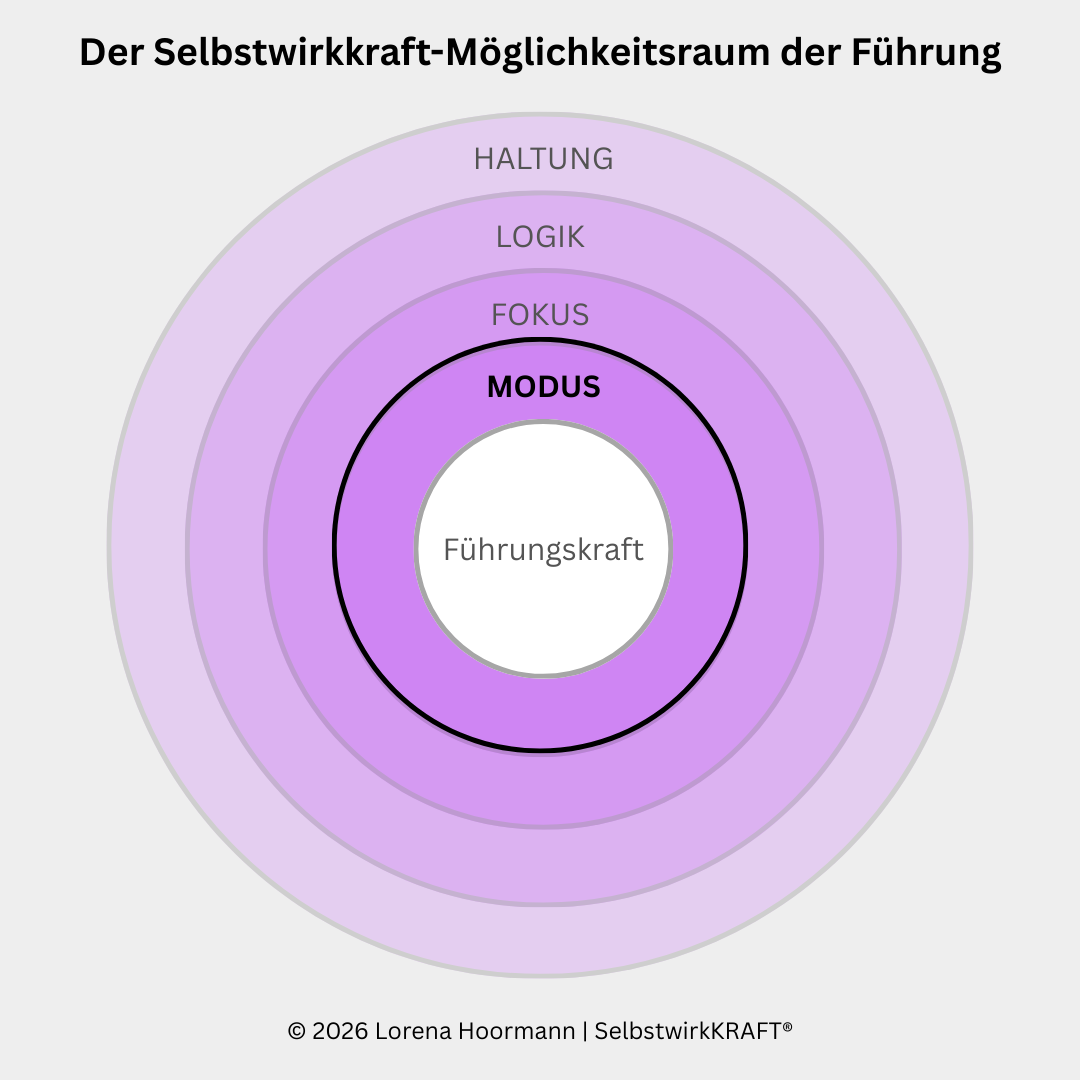
The Self-Agentic Power Possibility Space of Leadership: An Orientation Map Showing How Stance, Logic, Focus, and Modus Shape Leadership Action.
Even at the beginning of this series, it became clear that leadership is more than method or technique. It is not a set of tools that one merely needs to apply correctly. It often remains invisible that leadership is shaped not only by attitude, logic, or focus, but also by the inner mode in which it is carried out, the modus. Leadership is a form of inner organization. A certain degree of attention, control, regulation, presence. It doesn't just happen outwardly, but also inwardly. Depending on what this inner organization looks like, leadership costs different amounts of energy. Not situationally, but structurally.
2. The mode must be sustainable
Contents Different leadership styles have different energy requirements – their sustainability is crucial.
No mode is inherently right or wrong, or morally superior. What matters is not which mode is best. What matters is which mode is sustainable for the person in question—with their resources, available energy, etc.—under the conditions given in a situation. Different modes can be very sensible under certain conditions. It usually only becomes problematic when a mode permanently demands more energy than a person or situation can bear.
- Some modes require a consistently high cognitive presence, such as constant thinking, anticipating, or hedging. Much does not run automatically but requires conscious control. Decisions are prepared, considered, and supported by arguments. In such constellations, leadership quickly becomes cognitively expensive, even if it is successful in terms of expertise.
- Other modes are stronger relationship-oriented. They demand fine perception, emotional resonance, and the ability to tolerate ambivalence. This can also be sustainable and, at the same time, exhausting if emotional regulation becomes the main task on a permanent basis.
- Other modes focus on Control, structure, clear guidelines. They provide orientation and security, yet can be energy-draining if they have to be maintained against inner convictions or situational requirements.
Someone can have a reflective, engaged disposition and still lead in a way that is permanently overwhelming. Not because anything is wrong, but because leadership always occurs in an interplay of person, situation, and organizational context, and because the mode, the person, and the context don't align. The set focus influences how this mode is experienced, and personal limits play a central role – often more quietly than they should. This dynamic becomes particularly visible under pressure. Leadership then narrows. Familiar patterns kick in. Modes that have proven effective or are expected become stabilized. Leadership doesn't necessarily become worse, but it does become narrower. Less flexible. Less adaptable. What may still work in everyday life becomes increasingly strenuous under load.
3. Mode is not identity
Contents A leadership mode is not a fixed trait but a changeable mode of operation.
The realization that a mode is not an identity, not a personality trait, and not an unchangeable „that's just how I am“ can be relieving. A mode is a momentary operating state that can be changed, adapted, and also left behind. Not always immediately and not independently of structures, but certainly consciously.
Many managers initially experience this as a relief. Because if a mode is not a fixed characteristic but an operating mode, then change becomes conceivable at all.
This shifts the core question away from optimization and from „How can I lead even better?“ To the honest question: What is leadership costing me right now and why? And what kind of leadership would be sustainable for me under these conditions?
These questions do not resolve structural constraints. They do not change frameworks overnight. But they open up an intermediate space. A moment of self-awareness. And often, that is precisely the beginning of change.
4. Leadership that remains sustainable
Contents Leadership is often difficult not due to a lack of competence, but due to a permanently too expensive mode of operation.
Leadership in the appropriate mode doesn't mean avoiding demands. It also doesn't mean only doing what's easy. It means recognizing where leadership becomes permanently too expensive and where it remains sustainable for the person, the situation, and the system. Then, good leadership begins with the willingness to perceive one's own mode as real and to take it seriously, and to avoid permanently overtaxing oneself in the name of an idea of leadership that perhaps no longer fits.
Leadership often fails not due to a lack of competence, but because it is permanently organized in a mode that consumes too much energy. In the self-efficacy opportunity space of leadership, a simple but often overlooked dynamic emerges: attitude, logic, and focus shape, how Leadership is considered. The mode decides, how it is actually lived – and how much energy it permanently costs.
In the self-efficacy possibility space of leadership, this mode becomes visible as its own level – as that which is between Posture, Logic and Focus lived concretely.
5. Essence
Sometimes the problem with leadership lies not in decisions or capabilities, but in the mode in which it takes place. Leadership remains viable when its inner operating mode fits the person, the situation, and the system.
In this series, leadership was examined from four perspectives: Attitude, Logic, Focus, and Mode.
Together, they form the possibility space of leadership. They describe not methods, but levels on which leadership emerges – internal, relational, and organizational.
6. For your own reflection
Perhaps it is therefore worthwhile to occasionally consider leadership from an unusual perspective – not just about decisions or results, but about the inner operating mode in which it takes place. And in retrospect, not only to ask what was decided or how it was justified, but also:
- In what inner state did I lead? Was I open or closed? Present or tense?
- Where did leadership become cognitively expensive for me? Where did I have to constantly think ahead, safeguard, and control? Where did I invest a lot of energy without it being visible?
- Stress? Conflict? Expectation from above?
- What mode is implicitly expected in my environment?
- Where do I regulate more than is actually necessary?
- Where do I experience tension that could potentially be shared?
- Where do I take on responsibility that should be structurally distributed?
- Which of my personal boundaries do I regularly ignore in the name of "professionalism"? And what would change if I took this boundary seriously?
- When does leadership feel sustainable to me?
- How do I know my mode is right? How does my body react in those moments?
And the most important question, if all of this is conscious:
Which mode would cost less energy under these conditions and still remain effective?
Because sometimes change doesn't start with more effort, but with a more precise perception of what leadership is currently costing.
7. When reflection is to become design
Taking one's own leadership style seriously is not an abstract concept. Coaching repeatedly shows how relieving it is to understand exhaustion not as individual failure, but as an indication of an unsuitable modus. This process often begins with leaders being able to precisely name, for the first time, which modus is currently supporting them – and which is constantly exhausting them. This is precisely where I begin my work.
In leadership coaching, we clarify which operating mode leadership is currently taking place in, where it is permanently consuming energy, and where it will become sustainable—especially under pressure.
In workshops with leadership teams, for example on healthy leadership or in the context of change management, we jointly reflect on how collective modes emerge and how they influence performance, collaboration, and health.
And within the scope of corporate health promotion, it becomes clear how much sustainable organizations depend on leadership not being organized in a permanently cognitively expensive way.
If you sensed while reading that certain areas of tension affect you, perhaps a shared look at them is worthwhile.
Sometimes change doesn't start with a new method, but with a more conscious approach to your own leadership style. If you'd like to explore this perspective together, please feel free to sign up for a no-obligation initial consultation at info@hoormann-consult.com.
Series: Rethinking Leadership


0 Comments