
Leadership rarely begins where we might expect it, because it doesn't start with decisions, conversations, or visible actions, but before them. In the previous article in this series, we discussed posture and thus the inner framework from which situations are categorized. In many organizations, it becomes clear: Between what we consider right and what we actually do, there is another level. A level that operates subtly, yet is strongly structured. It determines what is considered reasonable, what can be justified, and what is postponed in case of doubt. This article is the third of seven contributions in the series „Leadership Reconsidered“He focuses on the logics that shape leadership—often invisible, often taken for granted, and precisely because of that, so effective.
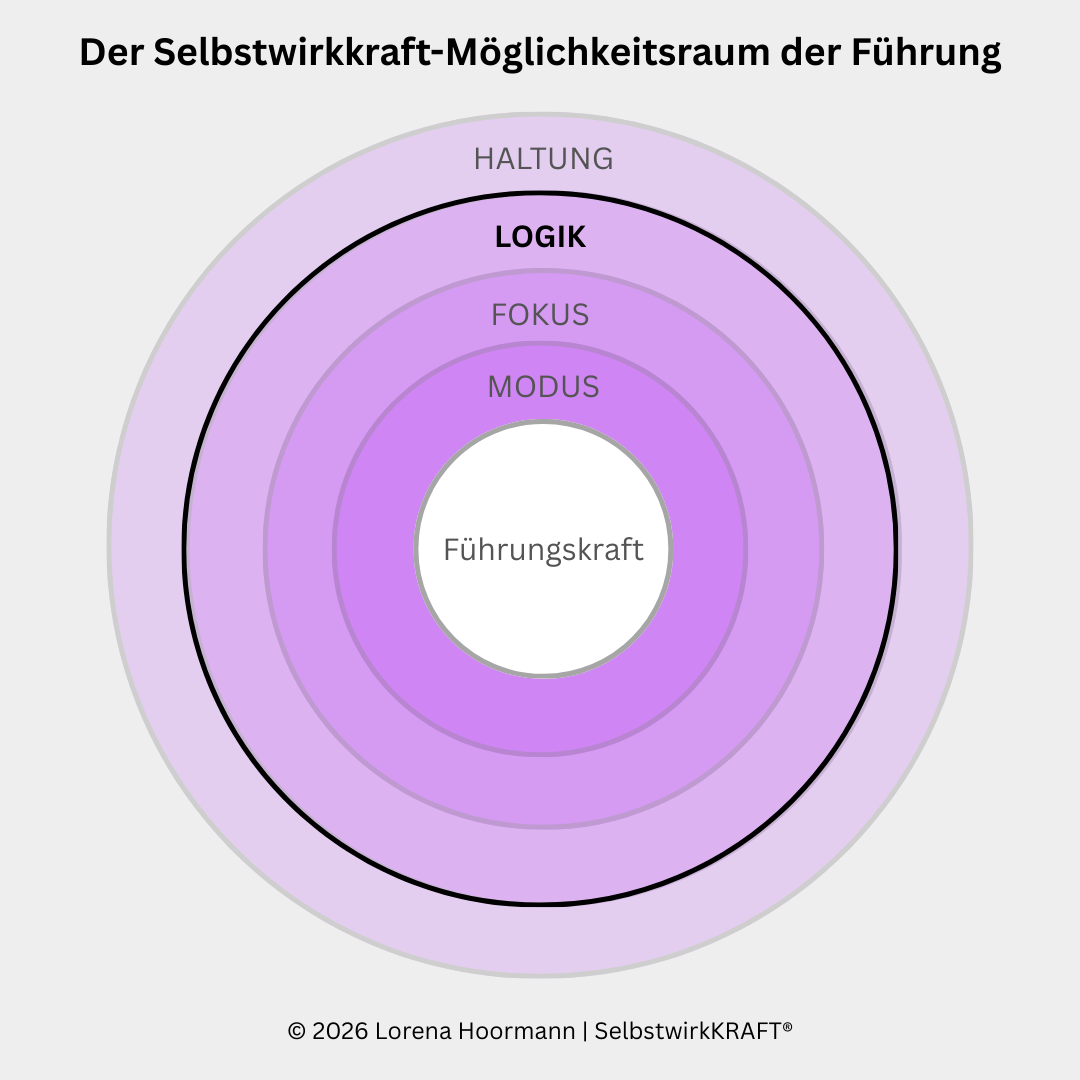
The Self-Agentic Power Possibility Space of Leadership: An Orientation Map Showing How Stance, Logic, Focus, and Modus Shape Leadership Action.
1. The tension behind decisions
Content: Many leadership situations are characterized by an inner tension when personal convictions and organizational logic diverge.
In many conversations about leadership, a peculiar tension arises sooner or later. People describe situations in which they actually wanted to act differently, in which they saw, felt, or understood something and yet decided otherwise. Not out of indifference or ignorance, but because they learned that in this organization „just like that“, because „you have to do it this way“ and „the framework leaves no other choice“.As early as the first article in the series, it became clear that leadership is often tied to individuals, even though it is highly context-dependent. This is precisely where it becomes apparent why this perspective is too limited.
2. Leadership arises from rationalities
Content: Leadership is shaped not only by attitude but also by organizational rationalities that determine what is considered reasonable and justifiable.
Leadership arises not only from attitude but also from logic. From the rationalities according to which decisions are made. From rules that determine what is considered reasonable, what appears feasible, and what can be justified as necessary. Often, these logics are not explicitly stated but are rather implicitly anchored culturally and are simply taken for granted. Precisely for this reason, they exert their influence. These logics are rarely meant personally. They belong to the system, the organization, the industry, the institutional fields. They structure decisions long before anyone consciously thinks about them. They define what counts, what is measurable, what can be justified, and what must be set aside in case of doubt. Within the "self-efficacy possibility space" of leadership, "logic" forms its own level between attitude and focus. It significantly influences which topics become dominant and which fade into the background.
3. Examples of effective leadership logics
Content: Different logics—such as economic, organizational, or political—shape how decisions are made and leadership is experienced.
- When efficiency becomes the guiding principle:
- One of these logics is the economic one. It appears when talking about efficiency, resources, goal achievement, budgets, or key performance indicators. In this rationality, leadership becomes management, alignment with results, and responsibility for output. This isn't wrong. In many contexts, it is necessary. And yet, in retrospect, it becomes clear how strongly this logic can overshadow other perspectives. Questions about workload, meaning, or development recede when targets dominate. This makes it noticeable how much logics influence which focuses are given space in leadership.
- When structures shape decisions:
- Next to that, an organizational logic is at play. It is evident in responsibilities, processes, workflows, in the statement:„That's how it's arranged here.“ Leadership here operates within structures that are meant to provide support, and sometimes take it away. Decisions appear less as an expression of personal conviction and more as the result of formal procedures, when responsibility is distributed, secured, and shifted. This can be relieving and paralyzing at the same time.
- When power implicitly entails:
- In many situations, a political logic is also at play, even if it is rarely named as such. It's about influence, interests, what can be said, and what is better left unsaid. Leadership here becomes a balancing act between loyalties, expectations, and visibility. In retrospect, it often becomes clear how much energy flows into this navigation and how little of it is officially discussed.
4. When logics contradict each other
Content: Many tensions in leadership arise when different logics are effective simultaneously.
These logics do not operate in isolation. They overlap, reinforce each other, or contradict each other. A leader can act from a clear, reflective stance and still make decisions that don't feel internally consistent. Not because the stance is missing. But because another logic is currently setting the tone. Logic becomes dominant, especially under pressure. Then, what can be justified, what is connectable, what has a place in the system counts. Leadership becomes less a question of wanting and more a question of being able to or being allowed to. And also a question of what fits here in this moment? Where are there already connection points?
In hindsight, many leadership processes show that conflicts often arise not between people, but between logics.
Many tensions in leadership are individualized, even though they are structurally ingrained. What appears to be a personal dilemma is often an expression of conflicting logics within the system.
Between what appears economically sensible and what would be humanly necessary. Between structural order and situational appropriateness. Between political wisdom and personal integrity.Even clear stances lose their impact under certain logics. The art lies in creating a good balance and connection here.
5. Design begins in contradiction
Content: Design becomes possible when contradictory logics are recognized and consciously reflected upon.
These tensions cannot be easily resolved. But they can be recognized and named. Merely doing so already shifts the attribution away from personal failure towards a more complex understanding of leadership in context. Perhaps this is one of the decisive steps in the development of leadership: to recognize which logic is currently at play and which is thereby being silenced. Not to free oneself from it, but to deal with it more consciously. Because leadership never arises solely from attitude. It always arises from the rules of the game in which it takes place. And sometimes, shaping begins precisely where these rules first become visible.
For many internal tensions in leadership arise not from a lack of stance, but from conflicting logics that are simultaneously effective. In the end, it will become clear that leadership emerges from the interplay of stance, logic, and focus.
6. Essence
Leadership doesn't just arise from attitude or personal decisions. It also arises from organizational logics that determine what is considered reasonable, possible, and justifiable. Many tensions in leadership are therefore less personal conflicts than expressions of contradictory system logics.
7. For self-reflection
Perhaps it's worth it, in retrospect of one's own situations, to focus not on one's own behavior, but on the logic that sets the tone in a given moment.
- What rationality is currently determining what is considered reasonable?
- What must be justifiable in my context?
- Which arguments are relevant and which are not?
- Where do I experience tensions that I've previously attributed to myself?
- Could there be contradictory logics at play here simultaneously?
- What logic is rewarded in my environment, and what logic remains invisible?
- And which ones would I strengthen if I had more creative freedom?
Sometimes leadership changes not through new tools or better communication. Sometimes it begins with seeing the rules of the game more consciously.
8. When reflection is to become design
Making logic visible doesn't remain theoretical. In coaching sessions and workshops, it becomes repeatedly clear how much different rationalities shape decisions and how relieving it can be to no longer understand tensions as personal failures, but as expressions of contradictory system logics.
This is exactly where I pick up in my work:
- In leadership coaching, we clarify individual areas of tension between attitude and organizational logic, especially where decisions are made under pressure. It's not about shutting down logic, but about dealing with it more consciously.
- In workshops with leadership teams, for example on healthy leadership or in the context of change management, we make dominant logics in the system visible and reflect on their impact on culture, collaboration, and decision-making processes.
- In the field of corporate health promotion, it becomes clear how deeply economic, organizational, and human logics are intertwined and how leadership can become a lever for sustainable change.
If you noticed during your reading that certain areas of tension can be recognized, perhaps a joint look at them would be worthwhile. If you would like to delve deeper into this together, feel free to contact me for a no-obligation initial consultation at info@hoormann-consult.com.
Series: Rethinking Leadership





Conflicts often arise not between people, but between logics. Between what seems economically sensible and what would be humanly necessary. Between structural order and situational appropriateness. Between political expediency and personal integrity. Many tensions are individualized even though they are structurally inherent. Even clear stances lose their effectiveness under certain logics. The art lies in creating a good balance and connection here.
If everyone, including the staff, understands this, it will significantly improve the working atmosphere.
Absolutely! That's one of the reasons I work with companies, teams, and leaders precisely on that. There's often a lot of untapped potential there.
Best regards,
Lorena
to consciously become aware of leadership. Wonderful! Thank you for this great contribution.
Dear Margot, thank you! Such an important topic 🙂