Leadership is not a static state.
It's a process that unfolds between people – or it doesn't.
And that's exactly what always irritates me in conversations about leadership. Because it's often spoken about so naturally, as if it's clear what is meant by it. We talk about leadership, about tools, about culture and competencies.
At the same time, I increasingly have the feeling that we're talking past each other.
Because when I look closer – in organizations, in projects, in conflicts, in completely ordinary workdays – then leadership doesn't show up where it's indicated on the organizational chart. And sometimes it's missing precisely where it would formally be intended.
This is irritating. And it's precisely this irritation that gave rise to this series. A series that doesn't start with methods – but with the question of what leadership actually is. Not from a desire to introduce a new model into the world. But from the observation that we too quickly categorize leadership. Evaluate too quickly. Want to optimize too quickly. Before we've even clarified what we mean by it.
In the upcoming articles of this series, I will therefore look step by step at different levels of leadership: at attitude, logic, focus, modes, and the personal. Not as a methodological model, but as different perspectives on how leadership actually emerges in everyday life.
Not to the next method. Not to the next framework.
But to the fundamental question: What does leadership mean today – beyond roles and methods?
Perhaps true leadership development begins right there. Not in doing. But in questioning what we have previously taken for granted.
This article is the first of seven in the article series "Rethinking Leadership.".
1. Leadership happens – and sometimes it doesn't
Content: Leadership often shows up in everyday life independently of formal roles – sometimes it arises spontaneously, sometimes it is absent despite a position.
When we talk about leadership, we quickly land on positions. On „the leaders.“ On responsibility. On decisions that need to be made. And yes - that's part of it. At least on paper. At the same time, in our daily lives, we repeatedly experience something that doesn't fit neatly into the organizational chart: people without formal leadership roles who provide direction because they bring calm, sort things out, and offer a path. And leaders who are formally in charge - yet in their environment, something happens that doesn't feel like leadership: unclear expectations, friction, a „we're waiting,“ a „we don't dare,“ sometimes even a „we're alone with this.“.
And then there are those situations where leadership suddenly emerges. Not necessarily planned. Not strategic. Not from a „leadership toolbox“ moment. But simply because someone does something that changes the room: a statement that names the situation. A decision that provides direction. A question that briefly takes the system off autopilot. And vice versa: situations where leadership seems to be completely lacking, even though everything would actually be there – experience, role, resources. This raises a fundamental question that has increasingly occupied me in recent years: What is leadership, really, if we don't tie it to titles, methods, or personalities?
2. Leadership cannot be fully codified.
Leadership is less a fixed position and more an event that arises in relationships and situations.
A common misconception is to equate leadership with a position. Those who hold a leadership role lead. Those who don't, don't. This sounds logical and is only partially valid in practice. Because leadership also happens without formal authority. And sometimes it fails to materialize despite formal power. Not as a „mistake“ in the classic sense, but because leadership is apparently not solely dependent on responsibilities, but is more complex. Perhaps leadership is less a position and more of an occurrence. Something that arises in relationships. In situations. In moments when direction is needed and someone takes responsibility for that direction, whether officially named or not.
Not every decision is leadership.
Not all responsibility is experienced as leadership.
And not all leadership can be attributed to a single person.
Leadership is not a static state. It is a process that unfolds between people, or it doesn't.
3. Leadership is never neutral
Leadership cannot be reduced to methods because its effectiveness always depends on the context and inner attitude.
At this point, the hope often arises that leadership can be „done right“ if one only knows the right method. Agile. Transformational. Situational. Servant Leadership. The list of leadership models is long – and many of them contain valuable perspectives. It becomes problematic where leadership is reduced to a technique. To tools, conversation guides, checklists that seemingly guarantee that things will go „well.“ Because the same method can – depending on the situation – be clarifying or hurtful, supportive or controlling, relieving or overwhelming. The difference rarely lies in the technique itself. It lies in the way leadership is exercised – and above all, in the starting point from which it originates.
Once leadership is no longer understood merely as a role or just a method, a different perspective opens up. Then it's less about Was and stronger around the How – and to the From where. Leadership is shown in how situations are perceived, what meanings we assign to them, what decisions follow from them – and what these decisions trigger in others. Leadership does not arise in a vacuum. It is embedded in contexts, dynamics, and expectations. And it is never neutral.
4. Why the same leadership has such different effects
Content: The same leadership action can have different effects because it is always carried out from specific perspectives and interpretations.
This becomes particularly clear when one observes how differently the same leadership action can be experienced. A sentence that provides clear direction for one person feels authoritarian to another. A decision intended to be courageous appears negligent from another perspective. An offer of support can be received as relief or as interference. These differences cannot be explained solely by individual sensitivities. They also arise because leadership always occurs from specific viewpoints. Every leadership action is embedded in an attitude, in a logic, in a focus – even if these are not explicitly stated.
In other words: Leadership is shaped by how we look at things – and by what we consider essential in a situation. Therefore, leadership is neither merely a personality trait nor a method. It is a relational and perceptual process.
5. Leadership arises on multiple levels simultaneously
Content: Leadership arises from the interplay of several levels – attitude, logic, focus, mode, and the person themselves.
If leadership is understood this way—as a process of perception and relationships—it's worth looking closer. What levels are actually interacting simultaneously when we lead? What dimensions blur in everyday life and become particularly noticeable under pressure? To make this visible, I have Leadership's self-efficacy possibility space developed.
In the graphic, the leader is at the center. Not as an isolated figure, but as part of a field. Concentric levels surround them: mode, focus, logic, and attitude. Like a force field that isn't always consciously perceived but is constantly at work. Leadership arises from the interplay of several levels: attitude, logic, focus, and mode. These levels act simultaneously – and collectively shape how leadership is actually experienced in everyday life.
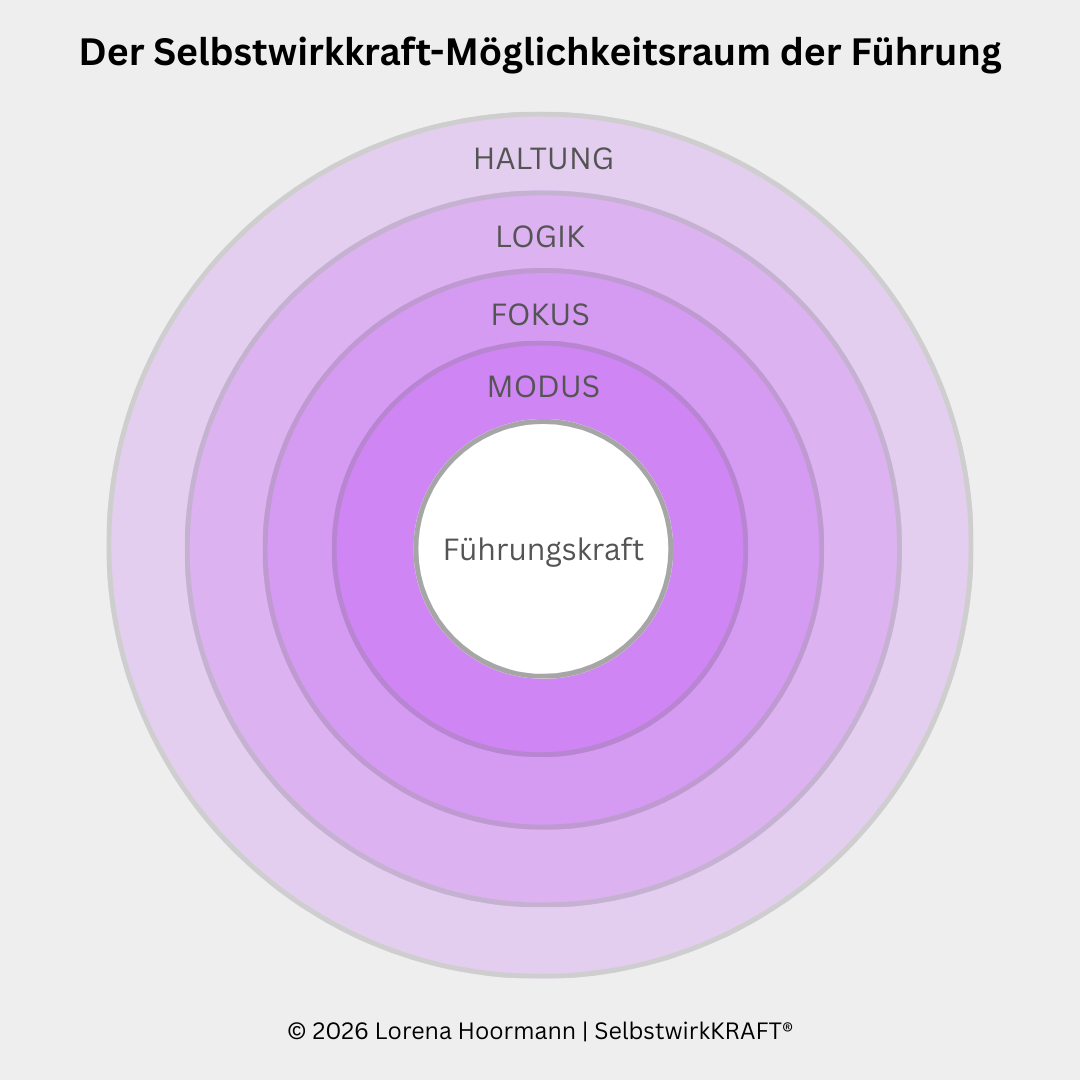 The Self-Effective Force-Possibility Space of Leadership: An Orientation Map Showing How Stance, Logic, Focus, and Mode Shape Leadership Actions.
- The Posture it forms the outer framework. It describes the fundamental way we interpret situations. Whether we read conflicts as a threat or as an opportunity for development. Whether we distrust or trust people. Attitude works quietly – but constantly.
- The Logic encompasses the rules and rationalities by which it is governed. Efficiency, safety, economic viability, relationships. Organizational and economic logics often frame leadership more strongly than we realize – sometimes even against our own values.
- The Focus shows where leadership focuses its attention: performance, development, stability, health, change, meaning. What we look at shapes what we see – and what we overlook.
- The Modus describes the inner state from which one leads. Tense or calm. Reactive or formative. Under pressure or with inner stability. The mode not only influences decisions – but also how much energy leadership costs.
- And in the middle of it all: the person themselves. With their own imprints, boundaries, biographical experiences, and inner themes. That too is part of the room of possibilities.
When leadership is viewed this way, the central question shifts. Leadership then appears less as a trait of individual people and more as an interplay of different levels: attitude, logic, focus, and mode – embedded in the personal and organizational context. Less „How do I lead correctly?“ and more: „What is effective in this situation right now, as I am leading?“ This shift changes the perspective. Away from blame and judgment. Towards perception, interpretation, and conscious design.
6. Outlook: Considering Leadership from Different Perspectives
Content: The series invites a more nuanced view of leadership and encourages conscious awareness of its different levels.
In the following articles in this series, I will explore these levels step by step: the attitudes from which leadership emerges. The logics that shape organizations – even against good intentions. The focuses to which leadership is directed, consciously or unconsciously. The modes that become effective. And the personal that always shapes leadership, even if it remains unspoken. Not to define the one right form of leadership, but to be able to view leadership in a more differentiated way. To make visible that leadership ability is more than method, tool, or position. That it has less to do with perfect answers and more to do with the ability to choose the appropriate perspective.
Because good leadership doesn't start with the role. It starts with how situations are perceived and interpreted. It's evident in the logic we're currently using. The focus we set. The mode in which we speak or make decisions. And the attitude we adopt – consciously or unconsciously.
Perhaps this is the start of a different question. Not „How do I lead better?“, but „What works within me when I lead?“. Perhaps good leadership starts exactly there: not with the method, but with the question of what actually works in a situation.
The following articles are an invitation to look more closely at exactly that. Because perhaps leadership doesn't lie first of all in what we do, but in the willingness to perceive what is working within us while we lead.
in Posture.
in Logic.
In the selected Focus.
In my own Modus.
And in that which personally resonates – often quietly, but effectively.
When leadership is viewed this way, a space of possibilities emerges. A space where self-efficacy does not need to be forced, but becomes visible. Step by step. Not to do something „right,“ but to consciously see what has long been at work.
Essence
Leadership cannot be explained solely through roles, methods, or personalities. It emerges from the interplay of attitude, logic, focus, mode, and the dynamics of a system.8. When reflection is to become design
The question of what leadership means today – beyond methods and roles – rarely remains theoretical. In coaching sessions and workshops, it becomes clear time and again how strongly leadership is still tied to positions or tools. And how relieving it can be to view leadership as a context-dependent process instead.
This is exactly where I pick up in my work:
- Leadership coaching is about understanding leadership not just as a task, but as an effect within a system. We clarify which implicit expectations are at play, which inner images of leadership are carried, and where new room for maneuver opens up.
- In workshops with leadership teams – for example, on healthy leadership or in the context of change management – we work to make leadership visible as a shared phenomenon. Not as a characteristic of individuals, but as an interplay of attitude, logic, focus, and context.
- And in the area of corporate health promotion, it becomes clear how much leadership understandings shape culture and how crucial it is to consciously shape leadership if organizations are to remain sustainably healthy.
If you noticed while reading that this perspective challenges or perhaps relieves you, then perhaps it's worth taking a closer look together.
Sometimes change doesn't begin with a new method, but with a different understanding of what leadership actually is. If you'd like to explore this perspective together, feel free to sign up for a no-obligation introductory call at info@hoormann-consult.com.
Series: Rethinking Leadership

0 Comments